
📖 How to Use This Guide
This guide may look long, but don’t scroll through everything. 👇
📑 Use the Table of Contents below to jump directly to any section. Simply click a section title to go there instantly.
⬆️ When you’re ready to visit another section, use the Back to Top button floating at the bottom-right corner of the screen to return to the Table of Contents.

🎥 Each section includes a video explanation from our YouTube channel. For the best viewing experience, we recommend watching it directly on YouTube using the “Watch on YouTube” button below the video.

🧭 For the best learning experience, follow the sections in the recommended order.
💡 Don’t worry if some terms or concepts seem confusing at first. Many topics are explained in later sections, and things will become much clearer as you progress through the guide.
✅ Start with the first section and work your way through step by step.
Table of Contents
- 📘 How to File and Administer Dividends for Canadian Owner-Managers: A Step-by-Step Compliance Guide
- 🏛 Verifying Share Class Rights: Ensuring Legal Eligibility for Dividend Payments in Canadian Corporations
- 📊 How to Accurately Calculate Dividend Amounts Per Share in Canadian Private Corporations
- ⚖️ Understanding the New TOSI Framework in Canada: How Contribution, Not Just Ownership, Determines Dividend Tax Treatment for Private Corporations
- 🚂 How to Navigate and Analyze Canada’s Complex TOSI (Tax on Split Income) Rules for Dividends – A Step-by-Step Process for Tax Practitioners
- 🚂 Understanding the Pathways Out of the TOSI Rules: How to Qualify for Dividend Taxation Exceptions and Avoid Highest Rate Tax on Split Income
- 🚪 Understanding TOSI Relief: Key Exceptions and Excluded Amounts for Canadian Owner-Manager Dividends
- 📊 TOSI Decision Charts, CRA Guidance, and Essential Resources for Dividend Analysis under Canadian Tax Rules
- 👷 Understanding the Excluded Business Exception: Proving Active Engagement for TOSI Relief on Dividends in Canadian Corporations
- 💰 Applying the Reasonable Return Test: Ensuring Dividends Match Shareholder Contributions for TOSI Compliance
- 🏢 Exploring the Excluded Shares Exception: TOSI & Dividend Planning for Non-Service Canadian Corporations
- 📜 How to Instruct Your Lawyer for Dividend Documentation: A Step-by-Step Guide to Updating Your Corporate Minute Book
- ⚖️ Can Accountants Maintain or Update Corporate Minute Books? Defining the Line Between Administrative Support and Legal Practice
- 📊 How to Decide When and How Often to Pay Dividends: Scheduling Strategies for Corporate Owner-Managers
- 💰 How Dividends Are Taxed in Canada: Payroll Remittance Requirements and Personal Tax Implications Explained for Owner-Managers
- 🧾How to Decide Whether to Pay Eligible or Ineligible Dividends: Tax Planning for Canadian Corporations and Owner-Managers
- 📄 Step-by-Step Guide to Year-End T5 Slip Preparation and Summary Filing for Canadian Dividends
- 🧓Reviewing a Client’s Current CPP Contribution Status for Effective Salary and Dividend Planning Decisions
📘 How to File and Administer Dividends for Canadian Owner-Managers: A Step-by-Step Compliance Guide
When working with corporate owner-managers, compensation does not always come in the form of salary.
The second major compensation method is:
💰 Dividends
Dividends can be tax-efficient — but they require proper legal documentation, tax compliance, and administrative discipline.
As a tax preparer, you must understand:
- How dividends are declared
- What documents are required
- How they are reported
- When special tax rules apply
- What filings must be completed
This section builds the foundation.
Video Explanation
💡 What Is a Dividend?
A dividend is a distribution of after-tax corporate profits to shareholders.
Unlike salary:
- ❌ No CPP contributions
- ❌ No EI deductions
- ❌ No payroll remittances
- ❌ No T4 slip
Instead:
- ✅ Reported on a T5 slip
- ✅ Taxed personally as dividend income
- ✅ Subject to dividend tax credit rules
Dividends are investment income — not employment income.
⚖️ Salary vs Dividend — Administrative Comparison
Salary
- Payroll account required
- Monthly remittances to the Canada Revenue Agency
- T4 issued
- CPP applies
- Creates RRSP room
Dividend
- No payroll account
- No CPP
- No RRSP room generated
- Requires corporate resolution
- T5 issued
Different income types require completely different compliance processes.
🏛 Dividends Must Be Properly Declared
This is where many beginners make mistakes.
Dividends cannot simply be “taken out” of the company.
They must be:
- 📜 Declared by directors
- Recorded in corporate records
- Supported by retained earnings
Proper declaration usually requires:
- A board resolution
- Documentation in the minute book
- Confirmation that share structure allows payment
Without documentation, the dividend may not legally exist.
📁 Corporate Minute Book & Legal Documentation
In many cases, you will need to:
- Prepare a dividend resolution
- Coordinate with the corporate lawyer
- Ensure share classes permit dividend distribution
- Record the declaration date
If multiple share classes exist, dividends must follow the share structure rules.
Administrative discipline protects the client.
🚨 The TOSI Rules (Tax on Split Income)
Dividend planning changed significantly due to TOSI rules.
Under TOSI:
- Certain dividends paid to family members
- May be taxed at the highest marginal tax rate
This restricts “income sprinkling.”
TOSI commonly affects:
- Spouses
- Adult children
- Minor children
- Related individuals
Before recommending dividends to family members, you must determine whether:
- An exception applies
- The business qualifies as excluded
- The shareholder meets active involvement tests
Never assume dividend splitting is permitted.
👨👩👧 When TOSI May Not Apply
TOSI may not apply if:
- The individual works actively in the business
- Ownership and age tests are satisfied
- The corporation meets excluded business criteria
Each case must be reviewed carefully.
This is now a core compliance step in dividend planning.
🧾 Filing Requirements for Dividends
When dividends are paid, you must:
- Prepare T5 slips
- File a T5 summary
- Report dividend income on the shareholder’s T1 return
T5 slips are generally due by the end of February following the calendar year.
Late filing penalties apply.
📋 Administrative Checklist Before Paying Dividends
Before dividends are issued:
- ✅ Confirm retained earnings are sufficient
- ✅ Verify share structure
- ✅ Prepare director resolution
- ✅ Record declaration date
- ✅ Record dividend payable in accounting records
- ✅ Issue payment
- ✅ Prepare and file T5 slips
This checklist should become routine in your practice.
🧠 Why Proper Administration Matters
Improper dividend handling can lead to:
- Reclassification issues
- Shareholder loan problems
- TOSI reassessments
- CRA scrutiny
- Legal documentation deficiencies
Clean administration reduces audit risk.
🏆 Key Takeaway
Dividends are not simpler than salary — they are different.
They require:
✔ Proper legal declaration
✔ Careful TOSI review
✔ Accurate documentation
✔ Timely T5 filing
✔ Clear communication with shareholders
Understanding dividend administration is essential for any tax preparer working with corporate owner-managers.
🏛 Verifying Share Class Rights: Ensuring Legal Eligibility for Dividend Payments in Canadian Corporations
Before declaring or planning any dividend, you must confirm one critical thing:
❓ Do the shareholder’s shares actually allow dividends to be paid?
This is the first administrative step in dividend planning — and it is often overlooked by beginners.
Dividends are not simply “money taken out of the company.” They must be legally permitted under the corporation’s share structure.
Video Explanation
📘 Why This Step Comes First
Even if:
- The corporation has profit
- The owner wants money
- The tax plan recommends dividends
You cannot proceed unless the share class allows it.
Ignoring this step can lead to:
- ❌ Invalid dividend declarations
- ❌ Paying the wrong shareholder
- ❌ Legal non-compliance
- ❌ CRA scrutiny
- ❌ Professional liability
📂 Step 1: Review the Minute Book (Always)
Never rely on what the client tells you.
Many clients say:
“We both own the company.”
That is not enough.
You must physically review:
- Articles of incorporation
- Share class descriptions
- Share register
- Shareholder agreements
- Any amendments to the articles
The minute book tells you:
- Who owns what class of shares
- What rights those shares carry
- Whether dividends are restricted
This step protects you.
🧾 Understanding Share Classes (Beginner Friendly)
Corporations can issue different types of shares:
- Common shares
- Preferred shares
- Special shares (Class A, Class B, etc.)
Each class can have:
- Voting rights
- Dividend rights
- Restrictions
- Priority rules
The dividend rights are what matter for compensation planning.
🟢 Scenario 1: Single Class of Common Shares
If:
- There is only one shareholder
- Only common shares exist
- No restrictions are listed
Dividends are usually straightforward.
This is the simplest structure.
🔵 Scenario 2: Multiple Classes for Income Splitting
Often corporations are structured like this:
- Spouse 1 owns common shares
- Spouse 2 owns special shares
This structure allows flexibility in dividend allocation.
However — you must confirm that:
- The special shares allow unlimited dividends
- There are no percentage caps
- There are no priority restrictions
⚠️ Common Restriction #1: Dividend Caps
Some incorporations (especially online templates) include clauses such as:
Dividends limited to a fixed percentage (e.g., 8%) of stated value.
Example:
If shares have $100 stated value and an 8% cap:
Maximum dividend = $8 per share
You cannot legally declare a large discretionary dividend.
If you attempt to, the dividend may not be valid.
⚠️ Common Restriction #2: Preferred Shares Paid First
Preferred shares often contain priority clauses like:
Preferred shareholders must receive dividends before common shareholders.
If:
- One spouse owns preferred shares
- The other owns common shares
You may be legally required to pay the preferred shareholder first.
If ignored, this can:
- Redirect income unintentionally
- Cause family disputes
- Trigger tax complications
Always check priority rules.
🚨 Why This Matters Even More Today
Dividend payments are increasingly scrutinized, especially where family members are involved.
With modern income-splitting restrictions and compliance reviews, tax authorities may examine:
- Share structures
- Dividend patterns
- Ownership documentation
If your dividend plan does not align with share rights, problems can arise quickly.
📞 When Share Structure Prevents Your Plan
If you discover that:
- Dividends are capped
- Priority rules prevent flexibility
- Share classes are poorly structured
Do not try to “work around” the issue.
Recommend consultation with:
- A corporate lawyer
- A corporate tax lawyer
They may suggest:
- Share reorganization
- Amending articles
- Creating new share classes
These changes must be done properly to avoid tax consequences.
📋 Professional Best-Practice Checklist
Before declaring dividends, confirm:
✔ Corporation has sufficient retained earnings
✔ Shareholder owns dividend-eligible shares
✔ No dividend caps exist
✔ No priority rules conflict
✔ Share register matches intended payment
✔ Documentation will be prepared
Document your review in your working papers.
🏆 Final Takeaway
Dividend planning starts with structure.
Before calculating tax savings or preparing T5 slips, you must first confirm:
📖 The share class allows dividends to be paid — in the amount and manner you intend.
If you master this step, you prevent administrative errors and protect both your client and your professional reputation.
📊 How to Accurately Calculate Dividend Amounts Per Share in Canadian Private Corporations
When declaring dividends in a corporation, you cannot simply decide how much each shareholder will receive.
Dividends must always be calculated:
💡 On a per-share basis
This is not optional. It is how dividends are legally declared and recorded in corporate minute books.
If you skip this step, your documentation will be incorrect.
Video Explanation
🧠 Why Dividends Must Be Calculated Per Share
Dividends are paid:
Per share — not per person.
The total dividend declared must be divided among the issued and outstanding shares of a specific class.
That per-share amount determines:
- How much each shareholder receives
- What gets recorded in the minute book
- What appears on each T5 slip
- Whether the allocation is legally correct
This is basic corporate law administration.
🔹 Example 1: Single Class of Common Shares
Assume:
- $100,000 dividend declared
- 100 common shares outstanding
- Two shareholders:
- Jason owns 67 shares
- Richard owns 33 shares
Step 1: Calculate Dividend Per Share
Total dividend ÷ Total shares
$100,000 ÷ 100 shares = $1,000 per share
Step 2: Allocate to Shareholders
Jason:
67 shares × $1,000 = $67,000
Richard:
33 shares × $1,000 = $33,000
There is no flexibility here.
Common shares must share equally per share.
You cannot choose a different split.
🔹 Example 2: Two Different Classes of Shares
Now assume:
- $100,000 total dividends declared
- Two classes:
- Common shares (Jason owns 100)
- Special shares (Richard owns 100)
The board declares:
- $67,000 dividend on common shares
- $33,000 dividend on special shares
Step 1: Calculate Per Share for Each Class
Common shares:
$67,000 ÷ 100 shares = $670 per share
Special shares:
$33,000 ÷ 100 shares = $330 per share
Important Rule
Each share class has its own per-share calculation.
You do not mix share classes.
If you mistakenly apply:
$1,000 per share to both classes
You would incorrectly allocate $100,000 to each class — doubling the intended dividend.
This is why careful calculations matter.
🔹 Example 3: Clearing a Shareholder Loan (Odd Amounts)
Sometimes dividends are declared to clear a shareholder loan balance.
Assume:
- Shareholder loan balance = $41,282.50
- Shareholder owns 37 shares of Class C
Step 1: Calculate Per Share
$41,282.50 ÷ 37 shares = $1,115.7432 per share
Yes — fractional cents are acceptable.
Dividends can include decimals.
You must calculate precisely to match the declared total.
If you round improperly, the total dividend will not reconcile.
📂 Why This Matters for Documentation
Corporate resolutions typically state:
“A dividend of $X per share is declared on Class ___ shares.”
Not:
“We are paying $100,000 total.”
The per-share amount is what makes the declaration legally valid.
It is also what lawyers record in the minute book.
📋 Administrative Checklist for Per-Share Calculations
Before preparing dividend documentation:
✔ Confirm number of issued and outstanding shares
✔ Confirm share class being paid
✔ Confirm total dividend declared
✔ Divide total by shares in that class
✔ Calculate exact per-share amount
✔ Multiply per-share amount by shares held by each shareholder
✔ Confirm totals reconcile exactly
⚠️ Common Mistakes Beginners Make
❌ Dividing by total shares across all classes
❌ Forgetting different classes require separate calculations
❌ Rounding incorrectly
❌ Allocating dividends based on percentages without calculating per-share
❌ Declaring total amount without computing per-share figure
🏛 Why Accuracy Is Important
Dividend records may be reviewed by:
- Corporate lawyers
- Accountants
- Tax authorities such as the Canada Revenue Agency
If per-share amounts do not reconcile:
- Minute book entries may be invalid
- T5 slips may be incorrect
- Dividend allocations could be challenged
🏆 Final Takeaway
Dividends are always declared:
📌 On a per-share basis
📌 By share class
📌 Based on issued and outstanding shares
Whenever you declare a dividend:
- Identify the class
- Count the shares
- Divide total dividend by shares
- Allocate accurately
Master this step and your dividend administration will be precise, professional, and legally sound.
⚖️ Understanding the New TOSI Framework in Canada: How Contribution, Not Just Ownership, Determines Dividend Tax Treatment for Private Corporations
Dividend planning in Canada changed dramatically after the introduction of the Tax on Split Income (TOSI) rules.
If you are becoming a tax preparer, this is one of the most important mindset shifts you must understand.
Before TOSI, many corporations used dividend sprinkling (also called income splitting) to reduce overall family tax.
Today, the rules are much stricter.
This section will give you the big-picture principle you must always keep in mind when advising on dividends.
Video Explanation
📜 What Are the TOSI Rules?
The TOSI rules were introduced through federal legislation (Bill C-74) and apply to certain types of income, including dividends received from private corporations.
They are enforced by the Canada Revenue Agency.
If TOSI applies:
💥 The dividend is taxed at the highest marginal personal tax rate.
No dividend tax credit benefit.
No low-income family advantage.
No income-splitting benefit.
In simple terms:
If you try to split income improperly, the tax savings disappear.
🎯 The Over-Arching Principle (The 300,000-Foot View)
Forget the complex rules for a moment.
Here is the guiding principle:
If the only reason a person owns shares is to save tax — TOSI will likely apply.
Ask yourself this:
- Did this shareholder invest capital?
- Did they contribute labour?
- Did they take financial risk?
- Did they guarantee loans?
- Are they actively involved in the business?
If the answer is “no” to all of the above…
And they are receiving dividends…
That is a red flag.
🧠 Think Like an Independent Third Party
A helpful way to analyze dividend situations is to step back and ask:
If this person was NOT related to the owner, would the company give them shares and pay them dividends?
If the answer is:
“No, that would make no business sense.”
Then you may be dealing with TOSI exposure.
Corporations do not normally give equity and dividends to people who:
- Contributed no money
- Provided no work
- Took no risk
- Provided no guarantees
If the only explanation is tax savings, that’s the danger zone.
👨👩👧 Why Family Dividends Are Under Scrutiny
Most TOSI situations involve:
- Spouses
- Adult children
- Minor children
- Other related individuals
Before TOSI, it was common to:
- Issue shares to family members
- Pay dividends to lower-income relatives
- Reduce overall family tax burden
Now, those arrangements are carefully examined.
If the dividend recipient is not genuinely contributing to the business, the income may be reclassified under TOSI.
🚨 What Happens If TOSI Applies?
If caught by TOSI:
- Dividend is taxed at top personal rate
- No benefit from lower marginal brackets
- No effective income splitting
- Potential reassessment and interest
This can significantly increase the tax bill.
📌 Important Distinction: Salary vs Dividend
TOSI mainly targets dividend income and certain other types of income.
Salary paid for actual work is generally not affected in the same way, provided it is reasonable.
That is why, in some cases, paying a reasonable salary may be safer than paying dividends.
🔍 The Logical Test You Should Always Apply
Before advising on dividend payments, ask:
- Why does this shareholder own shares?
- What value did they provide to the corporation?
- Would an unrelated third party in the same position receive dividends?
- Is this arrangement commercially reasonable?
- Is the primary motivation tax savings?
If the arrangement exists solely for tax reduction, you are likely on what some practitioners informally call the “TOSI train.”
🏛 Legislative Background (For Context)
The TOSI regime was expanded significantly in 2018 to address income sprinkling in private corporations.
It reflects a policy decision that:
Income should be taxed in the hands of those who genuinely earned or invested for it.
As a tax preparer, you are not just calculating numbers — you are evaluating substance.
📋 Practical Mindset for Beginners
When reviewing a client file:
✔ Identify all shareholders
✔ Determine relationships between them
✔ Understand their involvement in the business
✔ Review capital contributions
✔ Review loan guarantees
✔ Review historical dividend patterns
Then apply the overarching principle:
If this looks like pure tax splitting with no real business purpose, assume TOSI risk until proven otherwise.
🏆 Final Takeaway
The TOSI rules changed dividend planning completely.
You must move from:
“Can we split income to save tax?”
To:
“Does this shareholder genuinely deserve dividends based on capital, risk, or contribution?”
If not, the dividend may be taxed at the highest rate.
Master this overarching principle, and you will be far better prepared to navigate the detailed TOSI rules that follow.
🚂 How to Navigate and Analyze Canada’s Complex TOSI (Tax on Split Income) Rules for Dividends – A Step-by-Step Process for Tax Practitioners
The Tax on Split Income (TOSI) rules have fundamentally changed how dividends can be paid within family-owned corporations.
If you are training to become a tax preparer, you must understand this:
⚠️ Dividend sprinkling is no longer simple — and often no longer effective.
TOSI adds layers of complexity that directly impact owner-manager compensation planning.
Let’s break this down in a structured, beginner-friendly way.
Video Explanation
🧾 First: TOSI Is Not Completely New
TOSI has existed in some form since 1999.
You may have heard of the “kiddie tax.”
Under the original rules:
- Dividends paid to minor children (under 18)
- Were taxed at the highest marginal tax rate
This rule still exists.
For example:
If a 17-year-old receives a $100,000 dividend:
That income is taxed at the highest personal rate in their province.
There is no income-splitting advantage.
🔍 What Changed With the New TOSI Rules?
The major expansion of TOSI occurred in 2018.
The goal was to eliminate most forms of:
- Dividend sprinkling
- Family income splitting
- Passive shareholder tax planning
The rules are administered by the Canada Revenue Agency.
They now apply to:
- Certain adults aged 18–24
- Adults aged 25+
- Indirect ownership structures
- Trust structures
- Holding companies
- Related business income
This is where complexity increases.
📌 Who Does TOSI Potentially Apply To?
TOSI applies to income received:
By a specified individual
From a related business
In simple English:
If someone receives dividends from a business controlled by a related person (usually family), TOSI may apply.
This includes situations involving:
- Parents and children
- Spouses
- Corporations owned by family members
- Holding companies
- Trust beneficiaries
It is intentionally broad.
💥 What Happens If TOSI Applies?
If income is caught under TOSI:
- It is taxed at the highest marginal rate
- Most personal tax credits cannot be used
- Dividend tax credit benefits are effectively neutralized
In practice:
The tax savings disappear.
👶 Age Categories Matter
One reason TOSI is complex is because different rules apply depending on age:
- Under 18 → Automatic highest rate (kiddie tax)
- Age 18–24 → Additional restrictive tests
- Age 25+ → Different exclusion tests
Each age bracket has different qualification criteria.
This is why reviewing shareholder age is now a standard compliance step.
🧠 The Core Practical Rule
Always ask:
Is this shareholder genuinely involved in the business?
If they are not:
- No capital invested
- No labour provided
- No risk taken
- No guarantees signed
Then dividends paid to them are high risk for TOSI.
If the only reason they own shares is to reduce tax:
That is exactly what the legislation targets.
⚙️ Why TOSI Is So Complex
The legislation uses broad language like:
“Specified individuals receiving income from a related business directly or indirectly.”
That wording captures:
- Holding companies
- Multi-tier corporate structures
- Trust ownership arrangements
- Indirect shareholdings
It is intentionally comprehensive.
That is why TOSI analysis often feels overwhelming.
📉 Practical Reality for Owner-Managers
Because of TOSI:
Many corporations now avoid paying dividends to:
- University-age children
- Non-active adult children
- Passive spouses
Instead, they may:
- Pay reasonable salaries
- Or restrict dividends to active shareholders
This shifts planning away from dividend sprinkling and back toward employment-based compensation.
⚠️ Why We Call It the “TOSI Train”
Once income falls under TOSI:
It is difficult to escape the highest-rate taxation.
The goal becomes:
Identifying exclusions before paying dividends.
If you cannot confidently qualify for an exclusion, the conservative approach may be to avoid dividends altogether.
📋 Beginner Compliance Checklist
When reviewing dividends:
✔ Identify all shareholders
✔ Confirm ages
✔ Confirm involvement in business
✔ Confirm capital contribution
✔ Review related ownership structures
✔ Review holding companies or trusts
✔ Assess whether an exclusion applies
If no clear exclusion applies:
Assume TOSI risk.
🏛 The Current Landscape
The expanded TOSI rules are relatively new in legislative history.
Administrative interpretation continues to evolve.
The Canada Revenue Agency may refine enforcement patterns over time.
For now, conservative planning is common.
🏆 Final Takeaway
TOSI changed dividend planning permanently.
You must shift from:
“How can we split income?”
To:
“Does this shareholder legitimately qualify to receive dividends?”
If not, the income will likely be taxed at the highest personal rate.
Understanding this framework is essential before diving into the specific exclusions and detailed tests that follow.
🚂 Understanding the Pathways Out of the TOSI Rules: How to Qualify for Dividend Taxation Exceptions and Avoid Highest Rate Tax on Split Income
When analyzing dividends under the Tax on Split Income (TOSI) rules, you must start with the correct mindset:
🔴 Assume TOSI applies first.
🟢 Then look for an exception.
This is the safest and most professional way to approach dividend planning for corporate owner-managers.
Think of TOSI like a train 🚂.
By default, every dividend recipient is on the train.
Your job as a tax preparer is to determine whether they can legally step off.
Video Explanation
🧠 The Default Position: Everyone Is On the TOSI Train
Before you begin analyzing exclusions, understand this:
Under the expanded TOSI rules administered by the Canada Revenue Agency, dividends paid from a related business are generally assumed to be subject to TOSI unless an exception applies.
That means:
- Owner-managers
- Spouses
- Adult children
- Trust beneficiaries
- Holding company shareholders
All start on the train.
The burden is on you to determine whether they qualify to get off.
🚪 The “Doors” – Each Exception Is a Way Off the Train
Imagine each TOSI exception as a door on the train.
If the dividend recipient qualifies under any one exception, they step off.
Once they are off:
✅ TOSI no longer applies to that income.
❌ You do not need to test the other exceptions.
This is extremely important.
You do not need to satisfy all exceptions.
You only need to satisfy one.
🔍 How the Analysis Works in Practice
When reviewing a dividend payment, you work through the exclusions systematically.
For example:
- Is this an excluded business?
- Does the shareholder own excluded shares?
- Is the amount considered an excluded amount?
- Does a safe harbour test apply?
- Is the shareholder actively engaged?
You test each category one by one.
If one applies, you stop.
The person steps off the TOSI train.
📦 Key Concept: You Don’t Re-Board the Train
Once a shareholder qualifies under one exception:
They are not required to pass other tests.
For example:
If someone qualifies under the excluded shares exception:
You do not need to worry whether they qualify under the excluded business test.
They are already off the train.
This prevents unnecessary over-analysis.
⚖️ Example Scenario
Assume:
- A 30-year-old shareholder receives dividends.
- You begin reviewing TOSI.
You test:
- Excluded business? ❌ No.
- Excluded shares? ✅ Yes.
At that point, you stop.
TOSI does not apply.
You do not continue testing other exceptions.
📋 Why This Structured Approach Is Critical
The TOSI legislation is complex and layered.
Without structure, it can feel overwhelming.
By using the “train and doors” approach, you:
✔ Start from a conservative position
✔ Work methodically through exceptions
✔ Avoid missing an applicable exclusion
✔ Avoid unnecessary panic
✔ Apply consistent analysis across clients
This makes your workflow repeatable and defensible.
⚠️ Common Mistake Beginners Make
Many new tax preparers:
- Read one exception.
- Realize their client does not meet it.
- Assume TOSI automatically applies.
This is incorrect.
Failure to meet one exception does not mean failure overall.
You must test each possible exit.
🧾 Why This Matters for Owner-Managers
Family-owned corporations often involve:
- Multiple share classes
- Spouses
- Adult children
- Holding corporations
- Trust structures
Without a systematic process, it is easy to misapply TOSI.
The “TOSI Train” framework helps simplify decision-making in complex files.
📌 Administrative Best Practice
When reviewing dividend payments:
- Assume TOSI applies.
- Document each exception reviewed.
- Note which exception applies (if any).
- Stop once one exception is satisfied.
- Keep documentation in your working papers.
This protects both you and your client.
🏁 Final Takeaway
TOSI analysis is not about proving someone qualifies under every rule.
It is about finding one valid exception.
Remember:
🚂 Everyone starts on the train.
🚪 Each exception is a door.
✅ One open door is enough.
Once off the train, the dividend is no longer subject to TOSI.
This structured mindset will make navigating the complex TOSI rules far more manageable as you move deeper into each individual exception.
🚪 Understanding TOSI Relief: Key Exceptions and Excluded Amounts for Canadian Owner-Manager Dividends
Once you understand that everyone starts on the TOSI train, the next logical question is:
👉 How does someone legally get off?
Under the expanded Tax on Split Income (TOSI) regime administered by the Canada Revenue Agency, certain “excluded amounts” are carved out.
If a dividend qualifies as an excluded amount, it is not subject to TOSI and will be taxed normally.
For small business owner-managers, there are three primary exclusions you must understand:
- 🧠 Reasonable Return (Logic Test)
- 👷 Excluded Business (Active Involvement Test)
- 🏢 Excluded Shares (Good Shares Test)
While legislation includes more technical categories, these three are the most relevant for corporate owner-manager planning.
Let’s break them down clearly.
Video Explanation
🧠 1️⃣ The Reasonable Return Test (The Logic Test)
This is often called the “reasonable return” exception.
At its core, it asks:
Is the dividend reasonable based on the shareholder’s contributions?
Contributions may include:
- 💰 Capital invested
- 🧾 Assets contributed
- 💼 Work performed
- 📊 Risk assumed
- 📑 Guarantees provided
If the dividend reflects a reasonable return relative to those contributions, it may qualify as an excluded amount.
📌 Practical Example
Imagine:
- A shareholder invested $100,000 into a corporation.
- They receive a $5,000 dividend.
That is roughly a 5% return.
From a commercial perspective, that is reasonable.
Now compare that to:
- A shareholder who invested $1.
- They receive a $30,000 dividend.
That is not commercially reasonable in an arm’s length scenario.
The government asks:
Would an unrelated third party receive this return?
If the answer is no, TOSI risk increases.
⚠ Important Clarification
This test becomes stricter for individuals aged 18–24.
The legislation applies more restrictive standards to younger shareholders.
This means the “reasonable return” test is more limited for that age group.
👷 2️⃣ Excluded Business (Active Involvement Test)
This is the most important exclusion for small owner-managed businesses.
It is commonly referred to as the active involvement test.
To qualify:
The individual must be actively engaged in the business on a regular, continuous, and substantial basis.
This is often interpreted as meeting a bright-line threshold of 20 hours per week during the year (or historically meeting that threshold in prior years).
🏗 Example – Clearly Active
- George owns 100% of George’s Electrical Services Inc.
- He works full-time running jobs, managing staff, and performing electrical work.
George clearly qualifies under the excluded business rule.
Dividends paid to him are not subject to TOSI.
👩💼 Example – Spouse Involvement
- George’s spouse works 25 hours per week doing bookkeeping and administration.
If documentation supports regular and continuous involvement, she may qualify under the excluded business exception.
This is where documentation matters:
✔ Timesheets
✔ Payroll records
✔ Role descriptions
✔ Evidence of duties
🚨 Warning
If a shareholder:
- Owns shares
- Does not work in the business
- Does not contribute capital meaningfully
- Does not assume risk
They likely do not meet this exclusion.
🏢 3️⃣ Excluded Shares (The “Good Shares” Exclusion)
This is the most technical and restrictive exclusion.
To qualify, several conditions must be met, including:
- The shareholder owns at least 10% of votes and value.
- The corporation earns less than 90% of its income from services.
- The corporation is not a professional corporation.
- The income is not derived from a related business providing services.
⚖ Why This Is Complicated
This exclusion:
❌ Generally does not apply to professional corporations
- Doctors
- Dentists
- Lawyers
- Accountants
❌ Often does not apply to service-based businesses
The government intentionally limited this exclusion for service-type corporations.
It is more commonly available for:
- Manufacturing companies
- Product-based businesses
- Non-professional operating companies
📊 Quick Comparison Table
| Exclusion Type | Key Requirement | Most Relevant For | Complexity Level |
|---|---|---|---|
| 🧠 Reasonable Return | Dividend must reflect fair commercial return | Shareholders who contributed capital | Moderate |
| 👷 Excluded Business | Active, regular, substantial involvement | Owner-managers & working spouses | Most Common |
| 🏢 Excluded Shares | 10% vote & value + non-service income | Non-service businesses | High |
🎯 Which Exclusion Matters Most for Small Businesses?
For typical owner-managed corporations:
👉 The Excluded Business (Active Involvement) test is the most practical and commonly used.
The Reasonable Return test may apply in capital-heavy structures.
The Excluded Shares test is less common in service-based corporations.
📌 Practical Workflow for Tax Preparers
When reviewing dividends:
- Start with the assumption that TOSI applies.
- Test for Excluded Business first.
- If not met, test Reasonable Return.
- If applicable, analyze Excluded Shares.
- Document your reasoning.
If any one exclusion applies:
✅ TOSI does not apply.
🚪 The shareholder steps off the train.
⚠ The Overarching Reality
TOSI was designed to eliminate pure dividend sprinkling.
If dividends are paid to:
- Non-active family members
- Individuals who contributed little capital
- Passive shareholders
They are high-risk for TOSI.
The legislation forces business owners to justify dividend payments with economic substance.
🏁 Final Takeaway
For small business owner-managers, TOSI analysis revolves around three pillars:
🧠 Is the return reasonable?
👷 Is the shareholder actively involved?
🏢 Do the shares qualify as excluded shares?
Mastering these three concepts gives you a strong foundation for navigating dividend planning under modern TOSI rules.
As a developing tax preparer, this framework will allow you to approach dividend files with structure, confidence, and compliance awareness.
📊 TOSI Decision Charts, CRA Guidance, and Essential Resources for Dividend Analysis under Canadian Tax Rules
The Tax on Split Income (TOSI) rules are among the most complex provisions in Canadian personal tax planning.
Even experienced practitioners attend multi-hour seminars just to stay current.
As a beginner tax preparer, your goal is not to memorize every paragraph of legislation — it is to develop:
✔ A structured approach
✔ A decision-making framework
✔ A reliable reference tool
✔ Awareness of where to research further
This is where a quick reference chart and official guidance from the Canada Revenue Agency become essential.
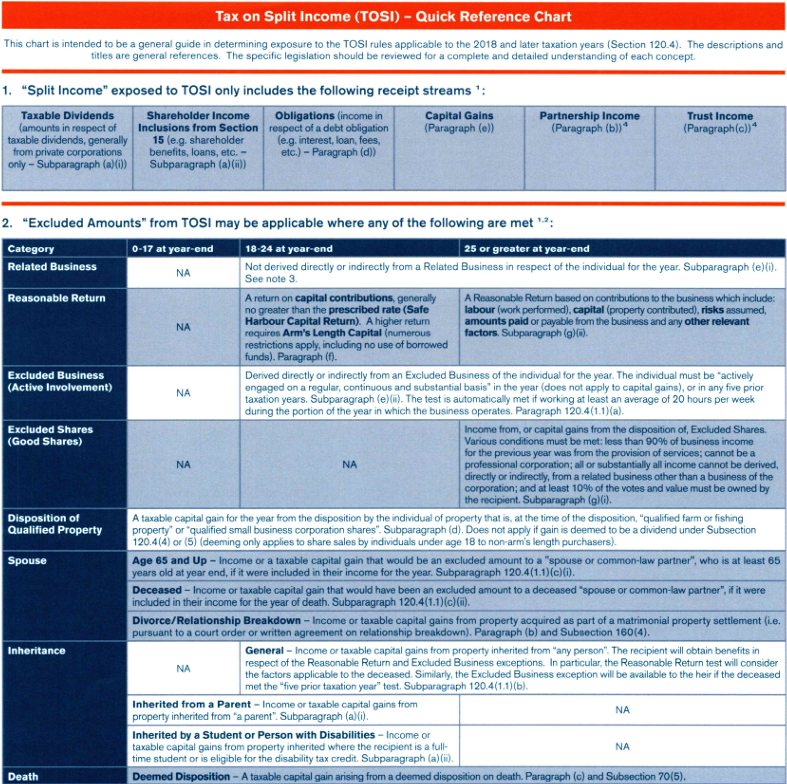
🧾 Step 1: What Income Is Even Subject to TOSI?
Before you look at exceptions, you must confirm whether the income is the type captured by TOSI.
The quick reference chart breaks income into specific categories, including:
- 💰 Taxable dividends (private corporations)
- 📌 Shareholder benefits (Section 15 inclusions)
- 📜 Certain shareholder income inclusions
- 💳 Obligations (interest, loans, etc.)
- 📈 Capital gains (in certain cases)
- 🤝 Partnership income
- 🏦 Trust income
While legislation lists categories individually, practically speaking:
If a shareholder receives income from a related business, assume TOSI risk exists.
Once income is identified as potentially caught, you are “on the TOSI train.”
Now the analysis begins.
Video Explanation
🚪 Step 2: Use the Chart to Identify Excluded Amounts (Your Exit Doors)
The reference chart organizes all excluded amounts into clear categories.
Each row represents a potential exit from TOSI.
If one applies, the dividend is taxed normally.
You do NOT need to qualify under every exception.
You only need one.
🧠 The Most Relevant Exclusions for Small Business Owner-Managers
While the chart lists many technical exclusions, for small owner-managed corporations, focus primarily on:
👷 Excluded Business (Active Involvement)
The individual must be actively engaged in the business on a regular, continuous, and substantial basis.
This is the most common and practical exclusion.
🧠 Reasonable Return
The dividend must reflect a reasonable return based on:
- Capital contributed
- Work performed
- Risks assumed
- Guarantees provided
If it resembles what an arm’s length investor would receive, it may qualify.
🏢 Excluded Shares
This requires meeting multiple technical tests including:
- 10% ownership of votes and value
- Less than 90% service income
- Not a professional corporation
- Limited related service income
This exclusion is detailed and often does NOT apply to service-based corporations (e.g., doctors, lawyers, accountants).
📌 Other Exclusions You Must Be Aware Of
Even if they are less common in small business files, you must understand they exist:
🏞 Disposition of Qualified Property
Includes:
- Qualified small business corporation shares
- Qualified farm or fishing property
These may be excluded from TOSI in capital gain situations.
👵 Age 65+ Spousal Exception
If a spouse is age 65 or older, dividends may qualify for exclusion similar to pension income splitting concepts.
This prevents unfair taxation on long-built family capital.
⚖ Divorce or Relationship Breakdown
Property received under court order or written separation agreements may qualify for exclusion.
⚰ Death & Deemed Disposition
Capital gains triggered on death are not meant to be subject to punitive TOSI treatment.
🎁 Inheritance
If adult children inherit shares, certain exclusions may apply.
The chart helps identify whether:
- The inherited amount qualifies
- Active involvement tests can transfer
- Reasonable return logic can apply
📊 Why the Chart Is So Powerful
Instead of flipping through legislative paragraphs, the chart gives you:
- Income types
- Age categories (0–17, 18–24, 25+)
- Applicable exclusions
- Legislative references
- Special notes
It allows you to visually:
- Identify the income
- Identify the age bracket
- Test the exclusions
- Confirm documentation requirements
🗂 Age Categories Matter — Always Check This First
The chart separates rules by age:
| Age Group | TOSI Strictness |
|---|---|
| 0–17 | Automatic highest tax (kiddie tax) |
| 18–24 | More restrictive tests |
| 25+ | Broader exclusions available |
This is critical.
Many beginners forget that age directly affects eligibility for exclusions.
📚 Why You Still Need to Review CRA Guidance
The chart is a summary tool.
But you must also:
- Review technical interpretations
- Monitor CRA updates
- Stay current with administrative guidance
The Canada Revenue Agency regularly publishes:
- Folios
- Technical interpretations
- Income Tax Technical News
- Updated administrative positions
TOSI is still evolving.
Enforcement patterns are developing.
⚠️ Important Professional Reality
Entire professional seminars are devoted solely to TOSI.
This means:
- You will not master it in one lesson.
- You must develop comfort with research.
- You must document your reasoning carefully.
If unsure, conservative planning is often safer.
🧩 Practical Workflow Using the Chart
When reviewing a dividend file:
1️⃣ Identify income type
2️⃣ Confirm shareholder age
3️⃣ Assume TOSI applies
4️⃣ Review exclusions row-by-row
5️⃣ Stop once one exclusion applies
6️⃣ Document the analysis
This structured process makes complex legislation manageable.
🏁 Final Takeaway
The quick reference chart is not a shortcut.
It is a navigation map.
TOSI is complex because it tries to prevent artificial income splitting while allowing legitimate business participation.
As a developing tax preparer, your responsibility is:
✔ Know what income is caught
✔ Understand the main exclusions
✔ Use structured tools
✔ Stay current with CRA guidance
✔ Document every decision
Mastering this framework will give you confidence when analyzing dividend compensation under modern TOSI rules.
👷 Understanding the Excluded Business Exception: Proving Active Engagement for TOSI Relief on Dividends in Canadian Corporations
When dealing with dividends under the Tax on Split Income (TOSI) regime, this is the exclusion you will rely on the most as a tax preparer working with corporate owner-managers.
For small family-owned corporations, the Excluded Business Test (Active Involvement Test) is often the strongest and most practical way to avoid TOSI applying to dividend income.
If this test is met:
✅ The dividend becomes an “excluded amount”
🚪 The shareholder steps off the TOSI train
💰 Dividends are taxed normally — not at the highest marginal rate
This section will give you a complete, practical understanding of how this exclusion works and how to apply it in real client files.
Video Explanation
📌 Why the Excluded Business Rule Exists
The government and the Canada Revenue Agency recognize a simple reality:
Family members often genuinely work in family businesses.
If someone:
- Actively works in the corporation
- Contributes meaningful labour
- Helps generate income
It would be unfair to tax their dividends at the punitive TOSI rate.
So the law allows an exclusion — but only if strict conditions are satisfied.
🔎 Core Eligibility Requirements
To qualify under the Excluded Business Test, the following conditions must be met:
1️⃣ The individual must be 18 years of age or older
2️⃣ The individual must be actively engaged in the business
3️⃣ The engagement must be regular, continuous, and substantial
Each of these words matters.
🚫 Age Requirement – No Minors Allowed
The exclusion does not apply to anyone under 18.
If a minor receives dividends:
❌ The kiddie tax rules apply
❌ Automatic taxation at the highest marginal rate
There is no workaround through the excluded business test for minors.
🔥 The Bright-Line Rule: 20 Hours Per Week
To simplify administration, the CRA introduced a bright-line threshold.
If the individual works:
📌 An average of at least 20 hours per week
📌 During the portion of the year the business operates
Then the “regular, continuous and substantial” test is automatically considered met.
This is extremely important.
It gives you an objective measurement.
🏗 What Does “During the Portion of the Year the Business Operates” Mean?
Some businesses are seasonal.
Examples include:
- Landscaping companies
- Snow removal businesses
- Seasonal tourism operations
- Agricultural operations
If a business operates only four months per year:
The 20-hour average applies only during those operating months.
You do not need 20 hours per week for the entire 12 months.
🧠 Real-Life Application Examples
✅ Example 1 – Full-Time Owner-Manager
- Works 40–60 hours per week
- Actively runs operations
- Makes business decisions
Clearly qualifies.
No TOSI concern under this exclusion.
✅ Example 2 – Spouse Working 25 Hours Per Week
- Manages bookkeeping
- Handles payroll
- Coordinates scheduling
- Manages accounts receivable
If averaging 20+ hours per week:
Dividends can qualify as excluded amounts.
❌ Example 3 – Adult Child Working 8–10 Hours Per Week
- Helps occasionally
- No structured role
- No documentation
Likely fails the bright-line test.
Dividends would likely be subject to TOSI.
📅 The Five-Year Historical Lookback Rule
This is one of the most powerful aspects of this exclusion.
Even if the individual does NOT meet the 20-hour threshold in the current year, the exclusion can still apply if:
✔ The individual worked an average of 20 hours per week
✔ In any five prior taxation years
Important clarifications:
- The five years do NOT need to be consecutive.
- They can be any five prior years.
- Once satisfied, the exclusion continues to apply going forward.
🧩 Example of the Five-Year Rule in Action
Adult child:
- Worked 20–25 hours per week during university summers
- Met threshold for five separate years
- Now has a full-time job elsewhere
Even though they no longer work in the business:
They may still qualify under the excluded business test.
This allows long-term dividend flexibility.
📂 Documentation: Your Protection in Case of CRA Review
Meeting the rule is one thing.
Proving it is another.
The CRA evaluates this on a factual, case-by-case basis.
You must maintain documentation.
📋 Recommended Documentation Checklist
✔ Timesheets
✔ Payroll records
✔ T4 slips
✔ Employment agreements
✔ Job descriptions
✔ Email communications
✔ Proof of responsibilities
✔ Historical payroll summaries
✔ Board resolutions referencing roles
If audited, documentation will determine success or failure.
⚠ Common Practical Challenge: Historical Proof
The five-year rule creates a real issue:
Most small businesses did not historically track detailed hours for family members.
If you plan to rely on past years:
You may need to reconstruct evidence using:
- Payroll records
- Historical T4 amounts
- Banking records
- Internal correspondence
- Sworn statements
The CRA has indicated flexibility, but proof must still be reasonable and credible.
📊 What Counts as “Substantial” Work?
The 20-hour test helps — but the work must also be meaningful.
Strong Examples of Substantial Work:
- Operations management
- Technical services
- Client management
- Financial oversight
- Administrative coordination
- Production supervision
Risky or Weak Examples:
- Occasional cleaning only
- Minimal social media posting
- Token symbolic duties
- Inflated reporting of hours
Substance matters.
The more essential the work is to business operations, the stronger your position.
📌 Quick Reference Summary Table
| Requirement | Must Be Met? | Key Notes |
|---|---|---|
| Age 18+ | Yes | No minors qualify |
| 20 hours/week average | Yes (bright-line) | During operating period |
| OR 5 prior qualifying years | Yes | Not consecutive |
| Regular, continuous, substantial | Yes | Evaluated factually |
| Documentation | Critical | Protects against reassessment |
🎯 Why This Is the Most Important TOSI Exclusion for Owner-Managers
For small corporations:
- Family members often legitimately work in the business
- Spouses commonly manage administration
- Adult children may help long-term
This exclusion preserves dividend flexibility for genuine contributors.
Without it, many family businesses would be forced to abandon dividend planning entirely.
🏁 Final Takeaway for New Tax Preparers
When reviewing dividend files under TOSI:
1️⃣ Confirm the individual is 18 or older
2️⃣ Verify 20 hours per week average (or 5 prior qualifying years)
3️⃣ Ensure work is meaningful and substantial
4️⃣ Gather and preserve documentation
5️⃣ Record your analysis in working papers
If those elements are satisfied:
🚪 The shareholder steps off the TOSI train
💰 Dividends are not subject to the highest marginal tax rate
Master this exclusion first.
It will be the cornerstone of your dividend planning strategy under modern TOSI rules.
💰 Applying the Reasonable Return Test: Ensuring Dividends Match Shareholder Contributions for TOSI Compliance
The Reasonable Return Test is one of the formal “excluded amount” exceptions under the Tax on Split Income (TOSI) rules.
While the Excluded Business (20-hour active involvement test) is often the primary tool for small business owner-managers, the Reasonable Return Test becomes extremely important in situations involving:
- 💵 Capital contributions
- 🏢 Property contributed to the corporation
- ✍ Loan guarantees
- 📊 Partial involvement in the business
- 👩💼 Spouses who support the business financially but not full-time
If structured and documented properly, dividends paid under this test can avoid TOSI and be taxed normally.
Let’s break this down carefully and practically.
Video Explanation
🧾 Step One: Age Categories Change the Rules
Under TOSI, the rules differ depending on age at year-end. The Canada Revenue Agency separates shareholders into:
- 👶 0–17 years old
- 🎓 18–24 years old
- 🧑 25 years and older
The Reasonable Return Test applies very differently depending on which category the shareholder falls into.
👶 Ages 0–17: No Access to the Reasonable Return Test
For minors:
❌ The kiddie tax rules apply
❌ Dividends are taxed at the highest marginal rate
❌ No reasonable return calculation is permitted
There is no flexibility here.
🎓 Ages 18–24: Restricted Reasonable Return (Prescribed Rate Model)
For individuals aged 18 to 24, the government assumes limited independent capital and imposes strict limits.
Here, the reasonable return is generally limited to:
- A return on arm’s length capital actually contributed
- Calculated using the prescribed rate
- No use of borrowed funds
- Strict tracing of capital
This is highly mechanical and restrictive.
📌 Example – 20-Year-Old Contributes Capital
Suppose:
- A 20-year-old contributes $50,000 of their own savings.
- The prescribed rate is 5%.
Reasonable return = $50,000 × 5% = $2,500.
A dividend around $2,500 may qualify.
A dividend of $25,000 likely would not.
The legislation is intentionally conservative for this age group.
🧑 Age 25 and Over: Broader, Flexible Logic Test
Once a shareholder is 25 or older at year-end, the analysis becomes more nuanced and flexible.
Now the test becomes:
🧠 Is the dividend reasonable based on the individual’s total contributions to the business?
This is sometimes called the “logic test.”
🔎 What Counts as a Contribution?
For individuals 25 and older, the following factors may support a reasonable return:
💰 Capital Contributed
- Cash invested at incorporation
- Share subscriptions
- Loans advanced
- Capital injections
- Reinvested dividends
Example:
If a spouse invested $200,000 at incorporation and receives a $10,000 dividend (5%), that may be reasonable.
🏢 Property Contributed
- Real estate used by the corporation
- Equipment or machinery
- Intellectual property
- Vehicles or tools
If a shareholder contributed a building used by the corporation, that is a meaningful economic contribution.
👷 Work Performed (Even Under 20 Hours)
Unlike the Excluded Business Test:
- The 20-hour bright-line rule does not apply here.
- Even 8–10 hours per week may count.
- Strategic or advisory involvement may count.
If a spouse handles marketing, vendor negotiations, compliance oversight, or administrative review, that work may support a reasonable return.
⚠ Risk Assumed
This is often overlooked but powerful.
Examples include:
- Personally guaranteeing bank loans
- Co-signing financing agreements
- Pledging personal assets as collateral
If a spouse guarantees a $500,000 operating line of credit, that is substantial economic risk.
That risk supports dividend payments.
📜 Historical Contributions
Past involvement and capital contributions can matter.
If a shareholder:
- Previously worked extensively
- Previously injected capital
- Previously guaranteed debt
Those historical factors may justify ongoing reasonable returns.
📊 Age Comparison Table
| Factor | Ages 18–24 | Age 25+ |
|---|---|---|
| Capital Contribution | Yes (strict) | Yes |
| Prescribed Rate Formula | Yes | No |
| Labour Contribution | Very limited | Yes |
| Risk Assumed | Limited | Yes |
| Subjective Case-by-Case Analysis | Limited | Yes |
🧠 What Does “Reasonable” Actually Mean?
There is no fixed percentage for those 25 and older.
Instead, the CRA evaluates:
- Industry norms
- Comparable market returns
- Size of capital invested
- Level of risk
- Nature of business
- Economic substance
The key professional question becomes:
Would an unrelated investor receive a similar return?
If yes, your position strengthens.
If no, TOSI risk increases.
📌 Practical Examples
✅ Scenario 1 – Moderate Return on Capital
- Invested: $300,000
- Dividend: $15,000
5% return.
Likely commercially defensible.
⚠ Scenario 2 – Minimal Contribution, Large Dividend
- Invested: $100
- Dividend: $40,000
Very difficult to defend as reasonable.
✅ Scenario 3 – Loan Guarantee + Partial Involvement
- No large capital injection
- Guaranteed major loan
- Works 10 hours per week
- Receives moderate dividend
Combined risk + involvement may support a reasonable return.
📂 Documentation Checklist
If relying on this test, documentation is critical.
Maintain:
✔ Share subscription agreements
✔ Loan agreements
✔ Property transfer documentation
✔ Loan guarantee contracts
✔ Financial statements
✔ Historical dividend records
✔ Capital contribution ledgers
✔ Board minutes referencing capital and risk
Without documentation, the argument weakens significantly.
⚖ Difference Between Active Involvement and Reasonable Return
| Active Involvement Test | Reasonable Return Test |
|---|---|
| Mechanical (20 hours/week) | Analytical & subjective |
| Bright-line threshold | Case-by-case evaluation |
| Focus on labour | Focus on capital, risk, labour |
| Most common | Secondary but powerful |
The reasonable return test is more flexible — but also more judgment-based.
🎯 When Should You Use This Test?
Use this test when:
- The shareholder does not meet the 20-hour rule
- There was meaningful capital contribution
- Significant financial risk was assumed
- Dividends reflect modest commercial returns
Avoid using it to justify aggressive income splitting.
📦 Professional Insight
In practice, for small owner-managed corporations:
- The Excluded Business Test will usually be your first approach.
- The Reasonable Return Test becomes valuable in spousal capital structures.
- It is particularly useful where one spouse funds the business but does not work full-time.
🏁 Final Takeaway
The Reasonable Return Test allows dividends to escape TOSI if they reflect genuine economic contributions.
Remember:
🔹 Ages 18–24 → Strict prescribed-rate limits
🔹 Age 25+ → Broader economic analysis
🔹 Must reflect real capital, labour, or risk
🔹 Documentation is essential
🔹 Dividend must be commercially defensible
This test requires professional judgment, economic reasoning, and careful documentation — but when applied correctly, it becomes a powerful tool in dividend planning under modern TOSI rules.
🏢 Exploring the Excluded Shares Exception: TOSI & Dividend Planning for Non-Service Canadian Corporations
The Excluded Shares Test is one of the most technical — and often misunderstood — exceptions under the Tax on Split Income (TOSI) rules administered by the Canada Revenue Agency.
For a beginner tax preparer, here is the key takeaway right from the start:
⚠️ This exclusion is narrow.
⚠️ It does NOT apply to most professional corporations.
⚠️ It does NOT apply to most service-based businesses.
⚠️ It requires strict ownership and structural conditions.
This section will give you a complete, structured understanding so you can confidently analyze whether a client qualifies.
Video Explanation
📘 What Is the Excluded Shares Test?
Under TOSI legislation, dividends received by certain individuals will not be subject to TOSI if those dividends are paid on shares that qualify as “excluded shares.”
If shares qualify:
✔ Dividends are taxed at normal marginal rates
✔ TOSI does not apply
✔ No highest-rate penalty taxation
However, all conditions must be satisfied.
🧾 Step 1: Age Requirement (25 or Older)
The shareholder must be:
- 🧑 25 years of age or older at the end of the taxation year.
If the individual is between 18–24 years old:
❌ The excluded shares test is unavailable.
They must instead rely on the reasonable return test (with prescribed rate limitations).
🗳 Step 2: Ownership Threshold — 10% Vote AND 10% Value
The shareholder must own:
- At least 10% of the voting shares, AND
- At least 10% of the fair market value of all issued shares.
Both requirements must be met.
⚠ Important Clarifications:
- Non-voting shares alone will not qualify.
- Owning 10% voting but only 5% value will not qualify.
- Preferred shares without voting rights generally fail.
This requirement forces genuine equity ownership — not token share issuance.
🚫 Step 3: Professional Corporations Are Excluded
This is one of the most critical restrictions.
The excluded shares test does NOT apply to:
- ❌ Law firms
- ❌ Accounting firms
- ❌ Dental corporations
- ❌ Medical corporations
- ❌ Other regulated professional corporations
Even if the spouse owns 50%, even if over 25, even if fully voting — this exclusion is unavailable.
Professional corporations were specifically carved out of this exception.
🏗 Step 4: The 90% Services Income Restriction
The corporation must not earn:
❗ 90% or more of its income from the provision of services.
If 90% or more of revenue is service income → excluded shares fail.
📌 What Is Considered “Service Income”?
Common examples:
- Consulting businesses
- IT contractors
- Personal service corporations
- Marketing agencies
- Engineering firms
- Financial advisors
- Freelance professionals
If the business primarily provides labour, expertise, or time — it is likely a service business.
📊 Quick Qualification Overview
| Requirement | Must Be Met? |
|---|---|
| Shareholder 25+ | ✅ Yes |
| Own ≥10% votes | ✅ Yes |
| Own ≥10% value | ✅ Yes |
| Not a professional corporation | ✅ Yes |
| Not 90%+ services income | ✅ Yes |
If any requirement fails → excluded shares do not apply.
🏢 Step 5: Related Business & Holding Company Complications
This is where complexity increases.
Consider this structure:
Operating Company → pays dividends → Holding Company → pays dividends → family shareholder
If the holding company’s income is derived from a related business, the excluded shares test may fail.
The legislation attempts to prevent:
- Dividend cascades
- Holdco income splitting
- Related-business flow-through planning
So if the dividend ultimately comes from a related operating business, TOSI risk remains.
🧠 Why This Rule Exists
The government introduced TOSI reforms to stop:
- Dividend sprinkling in service businesses
- Income splitting in professional corporations
- Passive holding company dividend chains
- Family members receiving dividends without real economic contribution
The excluded shares test was designed to protect:
- Genuine equity participation
- Non-service businesses
- Manufacturing and goods-producing corporations
It was not designed to preserve income splitting in professional or service contexts.
📦 Example 1 – Manufacturing Corporation (Possible Qualification)
Facts:
- Corporation manufactures furniture.
- 100% income from sale of goods.
- Spouse owns 20% voting common shares.
- Spouse owns 20% fair market value.
- Spouse is 40 years old.
✔ Age requirement met
✔ 10% vote requirement met
✔ 10% value requirement met
✔ Not professional
✔ Not service income
✅ Excluded shares likely apply.
Dividends may escape TOSI.
⚖ Example 2 – Consulting Business (Fails Services Test)
Facts:
- IT consulting corporation.
- 95% income from consulting services.
- Spouse owns 15% voting shares.
- Age 38.
❌ 90% services income restriction triggered.
Excluded shares unavailable.
Must rely on active involvement or reasonable return instead.
🏥 Example 3 – Professional Corporation (Fails Automatically)
Facts:
- Dental professional corporation.
- Spouse owns 25%.
- Age 50.
❌ Professional corporation exclusion.
The excluded shares test does not apply.
🏢 Example 4 – Holding Company Structure
Facts:
- Operating company earns active business income.
- Pays dividends to holding company.
- Holding company pays dividends to adult child.
Because income originates from a related operating business:
⚠ Excluded shares may not apply.
⚠ TOSI analysis required at individual level.
Holding companies do not automatically fix TOSI.
📂 Documentation Checklist for Practitioners
If attempting to rely on excluded shares, review:
✔ Articles of incorporation
✔ Share structure (classes & voting rights)
✔ Share register
✔ Ownership percentages
✔ Revenue breakdown (services vs goods)
✔ Corporate group structure
✔ Holding company relationships
Never assume eligibility without structural review.
🔍 Practical Reality for Most Small Businesses
In real-world small business practice:
- Most professional corporations will not qualify.
- Most consulting/service businesses will not qualify.
- Many holding company structures will not qualify.
- Manufacturing and goods-based companies may qualify.
This is why, practically, most owner-managers rely more heavily on:
1️⃣ Excluded Business (20-hour active involvement test)
2️⃣ Reasonable Return Test
The excluded shares test is secondary — and highly limited.
⚠ Why This Rule Is Confusing
This exclusion is complex because it combines:
- Age requirements
- Ownership thresholds
- Industry classification rules
- Professional carve-outs
- Related business analysis
- Holding company considerations
It is structural, not operational.
You must analyze corporate design — not just dividend payment.
🎯 Final Professional Takeaway
The Excluded Shares Test is:
🔹 Age restricted (25+)
🔹 Ownership-based (10% vote & value)
🔹 Not available for professional corporations
🔹 Not available for primarily service businesses
🔹 Complicated in holding company structures
It was intentionally drafted narrowly.
As a new tax preparer, your approach should be:
1️⃣ First test Active Involvement (20-hour rule).
2️⃣ Then analyze Reasonable Return.
3️⃣ Only then consider Excluded Shares — carefully and structurally.
If the ownership structure looks designed primarily to split income, TOSI risk is high.
Understanding this hierarchy will make you far more confident when advising owner-managed corporations under modern dividend rules.
📜 How to Instruct Your Lawyer for Dividend Documentation: A Step-by-Step Guide to Updating Your Corporate Minute Book
When dividends are declared in a corporation, it is not enough to simply record them in the accounting software or report them on the T2 return.
Dividends must be:
- ✅ Properly declared by directors
- ✅ Legally documented
- ✅ Recorded in the corporate minute book
- ✅ Reflected in resolutions
- ✅ Supported by share calculations
If this step is skipped, the dividend may be legally defective, even if tax was reported correctly.
As a tax preparer, this is where you move from “tax technician” to “corporate advisor.”
Let’s walk through this properly and practically.
Video Explanation
⚖ Why the Minute Book Must Be Updated
When a corporation declares dividends:
- The directors must formally declare them.
- The declaration must specify the class of shares.
- The amount must be determined on a per-share basis.
- The payment date must be recorded.
- The resolution must be added to the minute book.
Without this documentation:
⚠ The dividend may not be legally enforceable.
⚠ Lawyers may flag deficiencies later during reorganizations.
⚠ Buyers may question validity in due diligence.
⚠ CRA may question corporate compliance.
This is why year-end dividend letters to lawyers are essential.
🗂 What the Year-End Letter to the Lawyer Accomplishes
Your letter:
1️⃣ Confirms the dividends declared
2️⃣ Provides exact per-share calculations
3️⃣ Specifies declaration and payment dates
4️⃣ Identifies share classes involved
5️⃣ Supplies totals for resolution drafting
6️⃣ Ensures the minute book is legally updated
You are giving the lawyer everything needed to draft:
- Director’s resolution
- Shareholder resolution (if required)
- Dividend register entry
📅 Important Dates to Include
The letter must clearly specify:
- 📆 Corporate year-end date
- 📆 Date dividends were declared
- 📆 Date dividends were paid
- 📆 Date financial statements were finalized (optional but helpful)
💡 Practical Tip:
Many practitioners declare dividends a few days before year-end and pay a few days later — rather than declaring and paying on December 31.
Example:
- Declared: December 27
- Paid: December 29
Is this mandatory? No.
But it adds clarity and corporate formality.
📊 Per-Share Calculations Are Mandatory
Dividends must be declared per share, not simply as a lump sum.
If a corporation has:
- 73,661 Class A shares outstanding
- Dividend per share: $0.695
Then:
Total dividend = 73,661 × 0.695 = $51,194.40
This is the number that must appear in the resolution.
🏢 Sample Breakdown Format for Lawyer Letter
Below is a structured format you can use in your letter.
🔹 Corporation Year-End
December 31, 20XX
🔹 Dividends Declared
Declared on: December 27, 20XX
Paid on: December 29, 20XX
🔹 Dividend Details by Share Class
| Share Class | Shares Outstanding | Dividend Per Share | Total Dividend |
|---|---|---|---|
| Class A | 73,661 | $0.695 | $51,194.40 |
If multiple classes exist, repeat the breakdown:
| Share Class | Shares Outstanding | Dividend Per Share | Total Dividend |
|---|---|---|---|
| Class B | 10,000 | $1.25 | $12,500 |
Each class must be calculated separately.
🧮 Why Per-Share Detail Matters
Dividends are declared at the class level.
You cannot:
❌ Arbitrarily allocate different amounts to shareholders of the same class.
❌ Declare $100,000 and split it unevenly if they hold identical shares.
The calculation must respect:
- Number of issued and outstanding shares
- Share class rights
- Articles of incorporation
This protects legal integrity.
📑 Eligible vs Ineligible Dividends
Your letter should also clarify whether dividends are:
- 🔵 Eligible dividends
- 🟢 Non-eligible (ineligible) dividends
This matters for:
- T5 preparation
- Personal tax reporting
- Corporate GRIP balance
- Lawyer’s resolution wording
Make sure classification is correct before issuing instructions.
✍ What the Lawyer Does With Your Letter
Once received, the lawyer will:
1️⃣ Draft director resolution declaring dividend
2️⃣ Record per-share amount
3️⃣ Record payment date
4️⃣ Insert documentation into minute book
5️⃣ Update corporate registers
You are not drafting the legal resolution — you are supplying the numerical and tax details.
🛑 Common Mistakes to Avoid
❌ Forgetting to specify declaration date
❌ Forgetting payment date
❌ Not calculating per-share amount
❌ Using rounded totals that don’t tie
❌ Ignoring share class distinctions
❌ Failing to confirm shares outstanding
❌ Declaring dividends when retained earnings insufficient
Always verify share count before sending instructions.
📂 Documentation Checklist Before Sending Letter
✔ Confirm share register
✔ Confirm issued & outstanding shares
✔ Confirm share classes
✔ Confirm dividend classification
✔ Confirm sufficient retained earnings
✔ Confirm declaration date
✔ Confirm payment date
✔ Recalculate totals
Never rely on memory or assumptions.
🧠 Why This Is So Important for You as a Tax Preparer
When preparing year-end corporate files:
- You are often the first person to determine dividend amounts.
- The lawyer relies on your accuracy.
- Errors can create legal defects.
If the minute book is not updated:
- Corporate reorganizations become messy.
- Future estate freezes become complicated.
- Purchasers may request corrective resolutions.
- Additional legal fees may arise.
Your letter prevents these issues.
🏗 Example Full Instruction Summary (Simplified Format)
Please update the minute book of ABC Corp. to reflect the following dividend declaration:
Corporate Year-End: December 31, 20XX
Dividends declared on December 27, 20XX
Dividends payable on December 29, 20XXClass A Shares:
- 73,661 shares issued and outstanding
- Dividend declared: $0.695 per share
- Total dividend: $51,194.40
- Dividend type: Non-eligible
That is sufficient for the lawyer to prepare proper documentation.
📌 Final Professional Takeaway
Declaring dividends involves three layers:
1️⃣ Tax reporting (T2 and T5)
2️⃣ Accounting entries
3️⃣ Legal documentation in the minute book
All three must align.
As a tax preparer, your responsibility includes ensuring:
- Accurate per-share calculations
- Clear declaration dates
- Proper communication with legal counsel
- Clean corporate documentation
This simple letter prevents future corporate headaches.
If you build the habit of preparing structured, detailed dividend instruction letters every year, you will:
✔ Protect your client
✔ Protect yourself
✔ Maintain corporate integrity
✔ Avoid legal cleanup work later
And that is what separates basic compliance from professional practice.
⚖️ Can Accountants Maintain or Update Corporate Minute Books? Defining the Line Between Administrative Support and Legal Practice
This is one of the most common questions new practitioners ask:
🧐 “Can I update a client’s minute book myself?”
🧐 “Is it required every year?”
🧐 “Do I need a lawyer involved?”
If you’re becoming a tax preparer, this is an important professional boundary question — not just a technical one.
Let’s break this down clearly from:
- 📚 Legal perspective
- 🧾 Practical reality
- 🏢 Risk management angle
- 🧠 Professional judgment standpoint
Video Explanation
📘 First: What Is a Corporate Minute Book?
A corporate minute book is a legal record containing:
- Articles of incorporation
- Share registers
- Director registers
- Shareholder registers
- Annual shareholder minutes
- Director resolutions
- Dividend declarations
- Bonus approvals
- Share issuances
- Corporate changes
It is not an accounting file.
It is a legal document repository.
⚖️ The Technical Legal Answer
From a strict legal standpoint:
✅ Yes — the minute book must be updated annually.
✅ Yes — dividend declarations must be recorded.
✅ Yes — director resolutions must be documented.
Failure to update it means the corporation is not technically compliant with corporate law requirements.
So legally?
✔ It must be updated.
✔ Dividends must be declared properly.
✔ Resolutions must be recorded.
🏢 What Happens in Real-World Small Business Practice?
Here’s the reality in small owner-managed businesses:
- Many clients don’t know where their minute book is.
- Some have lost it.
- Many have not updated it in years.
- Most only update it when forced to.
When does it usually get updated?
🔎 When CRA audits
🔎 When shares are sold
🔎 When estate planning occurs
🔎 When there is a shareholder dispute
🔎 When the company is sold
Otherwise?
It often sits untouched.
🔍 Who Actually Looks at the Minute Book?
When the Canada Revenue Agency audits a corporation, one of the first requests is:
“Please provide the corporate minute book.”
Why?
They want to confirm:
- Who the directors are
- Who the shareholders are
- Who controls the corporation
- Who may be liable for GST/HST
- Who may be liable for payroll source deductions
They usually do not scrutinize every dividend resolution in detail.
But if something is missing, it can become an issue.
🧠 So… Can Accountants Update It?
This is where things become nuanced.
Technically:
Yes — accountants can draft resolutions.
But…
⚠️ Minute books contain legal documents.
⚠️ Lawyers are licensed to prepare legal documents.
⚠️ Professional accounting bodies often discourage preparing legal documents.
If you are a CPA or licensed professional, your regulatory body may frown upon preparing legal corporate documents without legal training.
📦 Risk-Based Practical Guidance
Let’s break this into scenarios.
🟢 Scenario 1: Sole Owner-Manager (Low Risk)
Example:
- George owns 100% of his electrical corporation.
- No other shareholders.
- No unrelated parties.
- No complex share structure.
In this case:
✔ Risk is low.
✔ Disputes unlikely.
✔ No minority shareholders.
Some accountants:
- Use templates.
- Prepare draft resolutions.
- Provide them to client.
- Suggest legal review.
This is common in small practices.
🟡 Scenario 2: Family Corporation (Moderate Risk)
Example:
- Husband and wife shareholders.
- Adult children shareholders.
- Dividend splitting involved.
Here:
⚠️ TOSI issues arise.
⚠️ Shareholder friction possible.
⚠️ Estate issues possible.
Better practice:
- Draft summary letter.
- Send instructions to lawyer.
- Avoid preparing final legal documents yourself.
🔴 Scenario 3: Unrelated Shareholders (High Risk)
Example:
- Three unrelated business partners.
- $5 million corporation.
- Multiple share classes.
In this case:
❌ Do NOT update minute book yourself.
❌ Do NOT draft final shareholder resolutions.
Why?
If a dispute occurs:
- Shareholders may challenge documentation.
- Legal errors may create liability.
- You could be pulled into litigation.
Always refer these to corporate lawyers.
🛡️ Best-Practice Risk Framework
| Situation | Recommended Action |
|---|---|
| Sole shareholder | Possibly draft template (low risk) |
| Family-owned | Prefer lawyer involvement |
| Unrelated shareholders | Lawyer only |
| Complex share classes | Lawyer only |
| Reorganizations | Lawyer only |
📝 Smart Compromise Strategy
If you want to stay involved but reduce liability:
✔ Prepare a draft resolution template
✔ Mark it clearly as “Draft – For Legal Review”
✔ Ask client’s lawyer to review and finalize
✔ Or ask your regular corporate lawyer for approved templates
Even better:
Ask a corporate lawyer to provide you with standard templates you can use going forward.
This way:
- A lawyer has vetted the structure.
- You are not inventing legal wording.
- You reduce risk.
📬 Always Do This (No Exceptions)
Regardless of who updates the minute book:
✔ Always send a year-end letter to the client.
✔ Always send a dividend summary letter to the lawyer.
✔ Always include declaration dates and per-share calculations.
✔ Always include dividend classification (eligible/non-eligible).
Even if the client ignores it, you have documented that you instructed them properly.
That protects you.
⚠️ What Happens If You Do Nothing?
If the minute book is not updated for years:
Eventually:
- CRA audit happens.
- Lawyer must backfill 5–10 years.
- Client pays large legal bill.
- Corrective resolutions required.
Many small businesses delay updating to save money — but it eventually catches up.
🧩 Key Professional Question
Ask yourself:
“If something goes wrong, do I want to defend this document in court?”
If the answer is no — let a lawyer prepare it.
🏁 Final Professional Takeaway
Yes — minute books legally must be updated annually.
Yes — accountants sometimes draft resolutions for simple sole-owner businesses.
But:
- They are legal documents.
- They carry legal liability.
- Shareholder disputes create risk.
- Professional bodies often discourage it.
🔹 Sole owner → Possibly manageable
🔹 Family structure → Caution
🔹 Unrelated shareholders → Always lawyer
The safest professional habit?
Always provide detailed dividend instruction letters and let the lawyer finalize the minute book.
That keeps you in your lane as a tax professional — and protects your practice long-term.
📊 How to Decide When and How Often to Pay Dividends: Scheduling Strategies for Corporate Owner-Managers
Dividends are one of the most common ways corporate owner-managers compensate themselves. However, a question that often arises for tax preparers and business owners is:
💬 How often should dividends be declared and paid?
Should they be monthly, quarterly, or once per year?
The answer is not strictly defined by tax law. Instead, it depends on corporate practice, documentation, and the specific needs of the shareholder(s). Understanding how dividends are typically handled in practice is essential for tax preparers who advise corporate clients.
Video Explanation
🧾 What Does It Mean to “Declare” a Dividend?
Before discussing frequency, it’s important to understand what declaring a dividend actually means.
📌 Dividend Declaration is a formal corporate action where the company’s directors approve distributing profits to shareholders.
This typically involves:
- A director’s resolution declaring the dividend
- Documentation recorded in the corporate minute book
- Payment to shareholders
- Issuing a T5 slip reporting dividend income
📦 Key Components of a Proper Dividend Process
| Step | Action |
|---|---|
| 1️⃣ | Board of directors declares the dividend |
| 2️⃣ | Dividend amount is determined |
| 3️⃣ | Payment is made to shareholders |
| 4️⃣ | Corporate records updated in the minute book |
| 5️⃣ | T5 slips issued to report the dividend |
⚠️ Important: Dividends cannot legally exist until they are formally declared.
📅 The Most Common Practice: Annual Dividends
For small owner-managed corporations, the most common approach is:
✅ Declaring dividends once per year (usually at year-end).
This is extremely common in real-world tax practice.
💼 Here’s how it typically works:
- The shareholder withdraws money from the corporation throughout the year.
- Those withdrawals accumulate in the Shareholder Loan Account.
- At year-end, the accountant calculates the total withdrawals.
- The company declares a dividend equal to the withdrawals.
- The shareholder loan balance is cleared.
📊 Example
| Description | Amount |
|---|---|
| Total withdrawals during the year | $80,000 |
| Dividend declared at year-end | $80,000 |
| T5 issued | Yes |
| Shareholder loan balance | Cleared |
📌 Result: The withdrawals are reclassified as dividend income instead of a shareholder loan.
⚙️ Can Dividends Be Declared More Frequently?
Yes. Corporations can legally declare dividends at any frequency.
Common options include:
| Frequency | Typical Use |
|---|---|
| Monthly | Structured dividend compensation |
| Quarterly | Businesses with periodic distributions |
| Annually | Most small owner-managed businesses |
However, monthly or quarterly dividends are rarely used in small businesses.
Why?
Because annual declarations are simpler and administratively easier.
💼 Example: Monthly Dividend Structure
Some business owners prefer to treat dividends like a monthly paycheck.
Example:
| Month | Dividend Paid |
|---|---|
| January | $4,000 |
| February | $4,000 |
| March | $4,000 |
| … | … |
In this scenario:
✔ Each dividend must technically be declared by director resolution
✔ The payment date should be documented
✔ Corporate records must reflect the payments
📌 Lawyers or accountants may update the minute book with monthly dividend declarations.
📊 Example: Quarterly Dividends
A shareholder may prefer quarterly payments instead.
Example:
| Quarter | Dividend |
|---|---|
| Q1 | $5,000 |
| Q2 | $5,000 |
| Q3 | $5,000 |
| Q4 | $5,000 |
| Total Annual Dividend | $20,000 |
This approach works well when dividends are only a portion of compensation, combined with salary.
Example structure:
| Compensation Type | Amount |
|---|---|
| Salary | $60,000 |
| Dividends | $20,000 |
| Total Compensation | $80,000 |
🧠 Why Most Small Businesses Prefer Annual Dividends
Most accountants recommend year-end dividend declarations for small corporations because they are:
✔ Simpler administratively
✔ Easier for bookkeeping
✔ Flexible for tax planning
✔ Compatible with shareholder loan clearing
📦 Benefits of Annual Dividends
- No need to prepare multiple corporate resolutions
- Easier year-end tax adjustments
- Less legal paperwork
- Reduced administrative costs
💡 Pro Tip for Tax Preparers:
Annual dividends allow you to decide the dividend amount during tax planning, after reviewing the company’s financial results.
⚠️ The Shareholder Loan Issue
One concern when shareholders withdraw money during the year is the Shareholder Loan Account.
📌 When a shareholder withdraws funds before dividends are declared, the withdrawal is technically treated as:
💰 A loan from the corporation to the shareholder
If this loan remains unpaid, tax problems may arise.
However, in practice:
➡ The loan is usually cleared with a year-end dividend declaration.
💡 What About Imputed Interest?
Under tax law, if a shareholder borrows money from their corporation interest-free, there could technically be an imputed interest benefit.
This means the shareholder might need to report a taxable benefit.
📊 Theoretical Scenario
| Situation | Tax Treatment |
|---|---|
| Shareholder withdraws $50,000 | Treated as shareholder loan |
| No interest charged | Possible imputed interest benefit |
| Dividend declared later | Loan cleared |
📌 In theory, interest could be calculated daily.
However…
🧾 Real-world tax audits rarely apply daily interest calculations for small owner-managed corporations.
Instead, auditors typically focus on:
- Whether the loan was cleared
- Whether the dividend was properly reported
🧑💼 Auditor Practice in the Real World
In most cases, tax auditors are satisfied if:
✔ The shareholder withdrawals match the declared dividend
✔ The dividend is properly documented
✔ A T5 slip is issued
Example:
| Description | Amount |
|---|---|
| Withdrawals during year | $80,000 |
| Dividend declared | $80,000 |
| T5 issued | Yes |
Result:
✅ Shareholder loan cleared
✅ Dividend reported for tax purposes
✅ Audit risk minimized
📜 When More Frequent Dividends May Be Recommended
More formal dividend policies are sometimes necessary in:
🏢 Larger corporations
👥 Companies with multiple shareholders
⚖️ Businesses with legal governance requirements
These companies may adopt:
- Formal dividend schedules
- Board resolutions each quarter
- Detailed minute book updates
📌 Example Policy
| Policy Type | Description |
|---|---|
| Monthly dividend policy | Declared on the last day of each month |
| Quarterly dividend policy | Declared at end of quarter |
| Annual dividend policy | Declared at fiscal year end |
📚 Best Practice for Tax Preparers
For most small owner-managed businesses, the recommended approach is:
✔ Track shareholder withdrawals during the year
✔ Review the shareholder loan balance at year-end
✔ Declare a dividend to clear the balance
✔ Issue a T5 slip for the dividend
📦 Simple Workflow
| Step | Action |
|---|---|
| 1 | Review shareholder withdrawals |
| 2 | Determine dividend amount |
| 3 | Prepare dividend resolution |
| 4 | Record in minute book |
| 5 | Issue T5 slip |
📌 Key Takeaways
🧾 Dividends can be declared at any frequency — monthly, quarterly, or annually.
However:
✔ Annual dividends are the most common practice for small corporations.
✔ They simplify bookkeeping and tax planning.
✔ Frequent dividends are mainly used in larger or more formal corporate structures.
💡 Bottom Line for Tax Preparers
For small owner-managed businesses:
🏆 Year-end dividend declarations are usually the most practical and efficient approach.
They reduce administrative burden while ensuring proper tax reporting and compliance.
💰 How Dividends Are Taxed in Canada: Payroll Remittance Requirements and Personal Tax Implications Explained for Owner-Managers
When corporate owner-managers decide how to compensate themselves, they often compare salary vs dividends. One major administrative difference between these two compensation methods is tax remittances.
For tax preparers and business owners, understanding how dividend taxes are paid — and when payments are required — is essential for proper planning and compliance.
The key takeaway is simple:
📌 Dividends do NOT require payroll remittances to the CRA.
However, that does not mean dividends are tax-free. Instead, the taxes are handled on the shareholder’s personal tax return.
Let’s break this down step by step.
Video Explanation
🧾 Salary vs Dividends: The Administrative Difference
One of the biggest differences between salary and dividends is how taxes are remitted to the CRA.
📊 Comparison Table
| Feature | Salary | Dividends |
|---|---|---|
| Payroll deductions required | ✅ Yes | ❌ No |
| Income tax withheld | ✅ Yes | ❌ No |
| CPP contributions | ✅ Yes | ❌ No |
| EI contributions | Sometimes | ❌ No |
| CRA remittances required | Monthly | None |
| Slip issued | T4 | T5 |
💡 Important Insight for Tax Preparers
Salary involves payroll compliance, while dividends are handled through personal tax filing.
📅 What Are Payroll Remittances?
When a corporation pays salary, it must withhold and remit taxes to the CRA.
These include:
💼 Employee Tax Deductions (ETD)
- Income tax
- CPP contributions
- EI contributions (if applicable)
⏰ Deadline
Payroll remittances are typically due:
📅 By the 15th of the following month
Example:
| Salary Paid | Remittance Due |
|---|---|
| January | February 15 |
| February | March 15 |
| March | April 15 |
⚠️ The CRA treats these funds as trust funds, meaning they must be remitted promptly.
Missing these deadlines often leads to:
- Penalties
- Interest
- CRA enforcement actions
💸 Dividends Do NOT Require CRA Remittances
Dividends operate very differently.
When a corporation pays a dividend to a Canadian resident shareholder, the company:
❌ Does NOT withhold tax
❌ Does NOT remit tax to the CRA
❌ Does NOT file payroll remittance forms
Instead:
📌 The corporation simply pays the dividend to the shareholder.
Example:
| Dividend Paid | Tax Withheld | CRA Remittance |
|---|---|---|
| $100,000 | $0 | $0 |
The company’s only responsibility is to:
📄 Issue a T5 slip reporting the dividend income.
📄 The Role of the T5 Slip
Dividends paid by Canadian corporations must be reported using a T5 slip.
The T5 reports:
- Dividend income received by the shareholder
- Type of dividend (eligible or non-eligible)
- Tax credits associated with the dividend
📅 T5 Filing Deadline
| Form | Deadline |
|---|---|
| T5 Slip issued to shareholder | End of February |
| T5 Summary filed with CRA | End of February |
Once the T5 is issued, the shareholder reports the dividend on their personal tax return (T1).
🧑💼 When Does the Shareholder Pay Tax on Dividends?
Dividends are taxed when the shareholder files their personal income tax return.
📅 Typical timeline:
| Event | Timing |
|---|---|
| Dividend received | During the year |
| T5 issued | February |
| Personal tax filing deadline | April 30 |
| Tax payment due | April 30 |
💡 This means there can be a significant delay between receiving dividends and paying tax.
⏳ The First-Year Tax Deferral Advantage
Because no taxes are withheld, dividends often create a temporary tax deferral.
Example scenario:
| Event | Date |
|---|---|
| Dividend received | July 2024 |
| T5 issued | February 2025 |
| Personal tax due | April 30, 2025 |
💰 This creates a deferral period of several months before taxes must be paid.
📦 Example
| Item | Amount |
|---|---|
| Dividend received | $150,000 |
| Estimated personal tax | $45,000 |
| Tax payment date | April 30 next year |
This allows the shareholder to use the funds for several months before paying tax.
⚠️ Why This Deferral Only Happens Once
The deferral advantage usually only occurs in the first year dividends are received.
Why?
Because the CRA introduces tax installment requirements once taxes become large enough.
💳 CRA Personal Tax Installments
If a taxpayer owes more than $3,000 in tax, the CRA typically requires quarterly installment payments.
📊 Installment Schedule
| Installment Date | Payment Due |
|---|---|
| March 15 | 1st installment |
| June 15 | 2nd installment |
| September 15 | 3rd installment |
| December 15 | 4th installment |
These payments are advance payments toward next year’s tax bill.
📊 Example: Dividend Installment Scenario
Suppose a shareholder receives:
💰 $200,000 in dividends
Estimated personal tax:
💵 $60,000
The CRA may require installments like this:
| Quarter | Installment |
|---|---|
| March 15 | $15,000 |
| June 15 | $15,000 |
| September 15 | $15,000 |
| December 15 | $15,000 |
Total installments:
💰 $60,000
These payments help prevent large balances owing at tax time.
⚠️ What Happens If Installments Are Not Paid?
Some taxpayers choose not to make installment payments.
If this happens:
📉 The CRA will charge interest on the unpaid installments.
However:
📌 The CRA typically does not aggressively pursue installment payments the same way it enforces payroll remittances.
📦 Real-World Behavior of Many Business Owners
Many owner-managers prefer to pay their entire tax bill at year-end instead of making quarterly installments.
Example:
| Dividend Income | $90,000 |
|---|---|
| Estimated tax | $25,000 |
| Installments paid | $0 |
| Tax paid | April 30 |
The CRA will likely charge:
💸 Installment interest
Some taxpayers accept this interest as a cost of convenience.
⚠️ When Installment Penalties Can Apply
Interest charges are common, but penalties may apply if installment interest becomes too high.
📌 CRA rule:
If installment interest exceeds $1,000, penalties may be added.
Example scenario:
| Situation | Result |
|---|---|
| Small missed installments | Interest only |
| Large missed installments | Interest + penalties |
This becomes more likely when dividend income is very large.
📌 Why Dividends Are Administratively Easier
From a compliance perspective, dividends are often simpler to administer than salary.
📊 Administrative Comparison
| Factor | Salary | Dividends |
|---|---|---|
| Payroll setup | Required | Not required |
| Monthly remittances | Required | Not required |
| CRA deadlines | Strict | Flexible |
| Compliance risk | High | Lower |
💡 For this reason, many small business owners prefer dividends when possible.
🧠 Practical Advice for Tax Preparers
When advising clients who receive dividends:
✔ Explain that no tax is withheld on dividends
✔ Remind them they will owe personal tax later
✔ Warn them about installment obligations
✔ Help them estimate future tax payments
📦 Good practice includes:
- Estimating personal tax annually
- Planning installment payments
- Avoiding large unexpected tax bills
🧾 Key Takeaways
📌 Dividends do NOT require payroll remittances to the CRA.
Instead:
- The corporation pays the dividend directly.
- A T5 slip reports the dividend income.
- The shareholder pays tax through their personal tax return.
💡 Important points to remember:
✔ No payroll deductions
✔ No monthly remittances
✔ Personal taxes due by April 30
✔ CRA may require quarterly installments after the first year
📚 Final Tip for New Tax Preparers
Understanding dividend remittances is essential when advising corporate clients.
🧠 Dividends shift the tax responsibility from the corporation to the individual shareholder.
This provides administrative flexibility, but also requires proper personal tax planning to avoid unexpected tax bills, interest, or installment penalties.
🧾How to Decide Whether to Pay Eligible or Ineligible Dividends: Tax Planning for Canadian Corporations and Owner-Managers
When a Canadian corporation pays dividends to its shareholders, those dividends must be classified as either eligible dividends or non-eligible (ineligible) dividends.
For tax preparers and corporate advisors, understanding how to choose between these two types of dividends is essential for effective tax planning.
The classification affects:
- 📊 The personal tax rate paid by the shareholder
- 🏢 The type of corporate income the dividend came from
- 📑 Corporate tax reporting
- 👴 Long-term planning for retirement and government benefits
This section explains how eligible and ineligible dividends work, when each type is used, and how to plan strategically for clients.
Video Explanation
📌 What Are Eligible vs Ineligible Dividends?
Canadian corporations generally earn income that is taxed at two different corporate tax rates:
1️⃣ Small business tax rate (lower rate)
2️⃣ General corporate tax rate (higher rate)
The type of tax paid determines which type of dividend can be distributed.
📊 Dividend Types Overview
| Dividend Type | Corporate Tax Rate Paid | Personal Tax Result |
|---|---|---|
| Eligible Dividends | Higher corporate tax rate | Lower personal tax |
| Ineligible Dividends | Lower small business tax rate | Higher personal tax |
💡 Key Idea
Eligible dividends are taxed more favorably at the personal level because the corporation has already paid higher corporate tax on that income.
🏢 The Two Corporate Income Pools
Corporations effectively have two pools of income that determine what type of dividends can be paid.
📉 1. Lower-Rate Income Pool (Small Business Income)
This pool contains income taxed at the small business tax rate.
Small businesses in Canada often receive the Small Business Deduction (SBD), which reduces the corporate tax rate on the first portion of active business income.
📊 Example
| Income | Corporate Tax Rate |
|---|---|
| First $500,000 of active business income | Small business rate (~12–15%) |
Income taxed at this lower rate can only be distributed as ineligible dividends.
📈 2. General Rate Income Pool (GRIP)
Income taxed at the higher corporate tax rate is tracked in a special pool called:
📘 GRIP (General Rate Income Pool)
This pool allows corporations to pay eligible dividends.
📦 Simple Definition
GRIP represents corporate income that was taxed at the general corporate tax rate, making it eligible for more favorable dividend treatment.
📑 Where Do Tax Preparers Find the GRIP Balance?
The GRIP balance is tracked in the corporate tax return.
📄 It appears on:
➡ Schedule 53 – General Rate Income Pool (GRIP)
This schedule tracks:
- GRIP additions
- GRIP reductions
- Eligible dividends paid
- Remaining GRIP balance
⚠️ Important for Tax Preparers
Always ensure Schedule 53 is properly updated, since it determines whether eligible dividends can legally be declared.
📊 Example: Corporate Income and GRIP
Let’s look at a simplified example.
A corporation earns $1,000,000 of profit.
Because of the Small Business Deduction:
| Portion of Income | Corporate Tax Treatment |
|---|---|
| First $500,000 | Small business rate |
| Remaining $500,000 | General corporate rate |
Result:
| Income Type | Dividend Type Allowed |
|---|---|
| $500,000 small business income | Ineligible dividends |
| $500,000 general rate income | Eligible dividends |
The second portion generates GRIP balance.
💰 Why Eligible Dividends Are Taxed More Favorably
Eligible dividends receive a larger dividend tax credit at the personal level.
Although eligible dividends have a larger gross-up, the dividend tax credit reduces the overall tax burden.
📊 Example Comparison
| Dividend Type | Dividend Received | Grossed-Up Income | Personal Tax (Example) |
|---|---|---|---|
| Ineligible Dividend | $80,000 | $93,600 | ~$9,000 |
| Eligible Dividend | $80,000 | $110,400 | ~$5,700 |
💡 Result
Even though the grossed-up income is higher, the tax credits are stronger, resulting in lower tax overall.
📦 Why Most Small Businesses Pay Ineligible Dividends
Many small corporations primarily earn income that qualifies for the Small Business Deduction.
Because of this:
➡ Their income is taxed at the lower corporate rate
➡ The income enters the lower-rate pool
➡ Only ineligible dividends can be paid
📌 Therefore:
Most small owner-managed corporations primarily distribute ineligible dividends.
Eligible dividends become available when corporations:
- Earn income above the small business limit
- Have investment income
- Pay general corporate tax rates
🧠 Practical Decision: Which Dividend Should Be Paid?
When a corporation has GRIP available, there may be a choice between paying:
- Eligible dividends
- Ineligible dividends
In most cases, eligible dividends are preferred because they produce lower personal tax.
📊 Typical Decision Framework
| Situation | Preferred Dividend Type |
|---|---|
| GRIP balance available | Eligible dividend |
| Only small business income | Ineligible dividend |
| Retirement planning | Depends on strategy |
👴 Retirement Planning Considerations
Dividend planning becomes especially important when shareholders approach retirement.
One factor to consider is government benefit clawbacks, particularly:
💰 Old Age Security (OAS)
📉 Why Eligible Dividends Can Trigger OAS Clawbacks
Eligible dividends have a larger gross-up factor.
This increases taxable income, even if the cash dividend is the same.
Example:
| Dividend Type | Dividend | Taxable Income After Gross-Up |
|---|---|---|
| Eligible dividend | $50,000 | $69,000 |
| Ineligible dividend | $50,000 | ~$58,500 |
Higher taxable income may cause:
🚨 OAS clawbacks
This reduces government pension benefits.
📊 Retirement Planning Strategy
For younger owner-managers:
✔ Paying eligible dividends earlier in life often makes sense because:
- Personal tax rates are lower
- GRIP is used efficiently
However, in retirement:
📌 Some planners prefer ineligible dividends because:
- Smaller gross-up
- Lower reported taxable income
- Reduced risk of OAS clawbacks
🧾 Example: Dividend Planning Over Time
Consider a business owner who retires at age 65.
During Working Years
| Strategy | Reason |
|---|---|
| Pay eligible dividends | Lower personal tax |
During Retirement
| Strategy | Reason |
|---|---|
| Pay ineligible dividends | Reduce taxable income and protect OAS |
📦 Strategic Tax Planning Tip
💡 Always consider the shareholder’s future income sources.
Important factors include:
- CPP benefits
- OAS benefits
- Pension income
- Investment income
- Dividend income
A large dividend gross-up can push income above government thresholds.
📊 Key Tax Planning Questions for Practitioners
When advising clients, tax preparers should ask:
📌 Does the corporation have GRIP available?
📌 What is the client’s current personal income level?
📌 Is the client approaching retirement?
📌 Will the dividend trigger OAS clawback?
The answers will guide the optimal dividend strategy.
📋 Practical Workflow for Tax Preparers
When preparing dividend planning:
Step 1: Review Corporate Tax Return
Check:
📄 Schedule 53 – GRIP balance
Step 2: Determine Available Dividend Types
| GRIP Available? | Dividend Options |
|---|---|
| Yes | Eligible or Ineligible |
| No | Ineligible only |
Step 3: Model Personal Tax Impact
Estimate:
- Personal income
- Gross-up impact
- Dividend tax credit
- Government benefit interactions
Step 4: Choose the Most Efficient Dividend Type
Select the option that:
✔ Minimizes total tax
✔ Avoids unnecessary clawbacks
✔ Fits long-term financial planning
📌 Key Takeaways for New Tax Preparers
🧾 Corporations can distribute two types of dividends:
- Eligible dividends
- Ineligible dividends
The type depends on how the corporation’s income was taxed.
✔ Income taxed at higher corporate rates → Eligible dividends
✔ Income taxed at small business rates → Ineligible dividends
💡 Important planning insights:
- Eligible dividends usually create lower personal tax
- Ineligible dividends may help avoid OAS clawbacks
- Always check the GRIP balance on Schedule 53
🎯 Final Professional Insight
Dividend planning is not just about current tax savings — it is also about long-term financial strategy.
Smart tax preparers consider:
📊 Corporate tax history
👴 Future retirement income
💰 Government benefit thresholds
📑 Corporate dividend pools
Understanding how to balance eligible vs ineligible dividends allows practitioners to provide high-value tax planning advice to corporate owner-managers.
📄 Step-by-Step Guide to Year-End T5 Slip Preparation and Summary Filing for Canadian Dividends
Whenever a corporation pays dividends to shareholders, the payment must be reported to both the shareholder and the Canada Revenue Agency (CRA). This reporting is done using the T5 slip and the T5 summary.
For tax preparers, preparing these forms correctly is a critical year-end compliance task. Fortunately, the process is much simpler than payroll reporting, because dividends do not require withholding taxes or remittances.
This section explains what a T5 slip is, when it must be filed, how to complete it correctly, and the practical workflow used by tax professionals.
Video Explanation
📌 What Is a T5 Slip?
A T5 slip is a tax form used to report investment income, including:
- Dividends paid by Canadian corporations
- Interest income
- Certain other investment payments
When a corporation pays dividends to shareholders, it must issue a T5 slip for each shareholder who received dividends during the year.
📦 Purpose of the T5 Slip
| Purpose | Explanation |
|---|---|
| Report dividend income | Shows the amount of dividends received |
| Inform shareholders | Helps shareholders report income on their personal tax return |
| Report to CRA | CRA receives a copy to match against personal tax filings |
💡 Key Concept
A T5 slip ensures that dividend income paid by corporations is properly reported on the shareholder’s personal tax return.
📅 T5 Filing Deadline
Dividends reported on T5 slips follow a strict filing deadline.
📆 Deadline:
➡ February 28 (or February 29 in leap years) following the calendar year in which dividends were paid.
📊 Example
| Dividend Paid | T5 Filing Deadline |
|---|---|
| 2024 dividends | February 28, 2025 |
By this deadline, the corporation must:
✔ Provide T5 slips to shareholders
✔ File the T5 summary with the CRA
✔ Submit copies of all T5 slips to the CRA
🧾 What Is the T5 Summary?
The T5 summary is a form that accompanies all the T5 slips filed by a corporation.
Think of it as a cover page that summarizes the total dividends reported.
📦 T5 Summary Purpose
| Function | Description |
|---|---|
| Consolidates dividend totals | Shows total dividends paid |
| Lists number of slips issued | Counts all shareholders receiving dividends |
| Reports totals to CRA | Provides a summary of all T5 slips |
The CRA uses this form to ensure the total of all individual T5 slips matches the corporate report.
💰 Types of Dividends Reported on the T5
When completing the T5 slip, the corporation must specify whether dividends are:
1️⃣ Eligible dividends
2️⃣ Non-eligible (ineligible) dividends
This classification affects how the dividend is taxed on the shareholder’s personal tax return.
📊 Dividend Reporting Boxes
| T5 Box | Dividend Type |
|---|---|
| Box 10 | Non-eligible (ineligible) dividends |
| Box 24 | Eligible dividends |
📊 Example: Reporting an Ineligible Dividend
Assume a corporation pays a shareholder:
💰 $80,000 in ineligible dividends
On the T5 slip:
| Box | Amount |
|---|---|
| Box 10 | $80,000 |
The tax software or CRA system automatically calculates:
- Dividend gross-up
- Dividend tax credit
These amounts are used by the shareholder when preparing their personal tax return.
📊 Example: Reporting an Eligible Dividend
Now assume the corporation pays:
💰 $80,000 in eligible dividends
On the T5 slip:
| Box | Amount |
|---|---|
| Box 24 | $80,000 |
Because eligible dividends receive a larger gross-up, the shareholder’s taxable income becomes higher, but they also receive a larger dividend tax credit, which often reduces the final tax payable.
⚖️ Can a Dividend Be Both Eligible and Ineligible?
Yes. A dividend payment can be split between eligible and ineligible portions.
This happens when:
- The corporation has limited GRIP balance, or
- Only part of the dividend qualifies as eligible.
📊 Example Scenario
A corporation pays a total dividend of:
💰 $80,000
However, only $35,000 of GRIP is available.
The dividend would be reported as:
| Dividend Type | Amount |
|---|---|
| Eligible dividend | $35,000 |
| Ineligible dividend | $45,000 |
| Total dividend | $80,000 |
On the T5 slip:
| Box | Amount |
|---|---|
| Box 24 | $35,000 |
| Box 10 | $45,000 |
This allows corporations to distribute available eligible dividends first, while the remaining amount is classified as ineligible.
🧾 Corporate Schedules That Must Match the T5
When preparing dividend reporting, several corporate tax schedules must align.
📄 Important schedules include:
| Schedule | Purpose |
|---|---|
| Schedule 3 | Dividends paid |
| Schedule 53 | GRIP balance tracking |
| T5 slips | Dividend reporting to shareholders |
| T5 summary | Total dividend reporting to CRA |
Tax preparers must ensure these documents match exactly to avoid discrepancies.
🚫 No CRA Remittances for Dividends
One major advantage of dividend reporting is the lack of payroll remittance requirements.
Unlike salary payments:
❌ No income tax withholding
❌ No CPP deductions
❌ No EI deductions
❌ No monthly CRA remittances
📦 This means the T5 process is administratively simpler than payroll reporting.
📊 Dividends vs Payroll Reporting
| Feature | Payroll (Salary) | Dividends |
|---|---|---|
| Withholding taxes | Required | Not required |
| Monthly remittances | Required | None |
| CRA payroll account | Required | Not required |
| Reporting slip | T4 | T5 |
| Filing deadline | End of February | End of February |
💡 For tax preparers, dividends are often much easier to administer than payroll.
🧠 Typical Year-End Workflow for Tax Preparers
Preparing T5 slips usually happens during corporate year-end tax preparation.
📋 Standard workflow:
Step 1: Determine Total Dividends Paid
Review:
- Shareholder withdrawals
- Dividend declarations
- Corporate minute book
Step 2: Identify Dividend Type
Check whether dividends are:
✔ Eligible
✔ Ineligible
✔ A combination of both
This depends on the GRIP balance and corporate tax calculations.
Step 3: Prepare T5 Slips
Create a T5 slip for each shareholder.
Include:
- Shareholder name and SIN
- Dividend amounts
- Dividend type classification
Step 4: Prepare T5 Summary
Summarize:
- Total dividends paid
- Total number of T5 slips issued
- Corporate information
Step 5: File with CRA
By February 28, the corporation must:
✔ Provide T5 slips to shareholders
✔ File T5 summary with CRA
✔ Submit copies of all slips
📌 Common Scenario for Small Businesses
Most small Canadian corporations earn income below the Small Business Deduction limit.
As a result:
✔ Corporate income is taxed at the small business rate
✔ The corporation does not accumulate GRIP
✔ Dividends are usually entirely ineligible
📦 Example
| Corporate Profit | Dividend Type |
|---|---|
| $300,000 | Ineligible dividends |
This makes the T5 reporting straightforward, since only Box 10 is used.
⚠️ Common Mistakes to Avoid
New tax preparers should watch for these frequent errors.
❌ Forgetting to file T5 slips
❌ Missing the February deadline
❌ Misclassifying eligible vs ineligible dividends
❌ Not updating GRIP calculations
❌ Mismatching T5 slips with corporate schedules
💡 Even though dividends are administratively simple, accuracy in classification is critical.
📚 Key Takeaways for Tax Preparers
📌 Whenever a corporation pays dividends, it must:
✔ Issue T5 slips to shareholders
✔ File a T5 summary with the CRA
✔ Meet the February filing deadline
Key points to remember:
- Eligible dividends → Box 24
- Ineligible dividends → Box 10
- Dividends may be split between both types
- No CRA remittances are required
🎯 Final Professional Insight
From a compliance perspective, T5 reporting is one of the simplest administrative tasks in corporate taxation.
However, accurate preparation still requires tax preparers to:
📊 Understand dividend classifications
📑 Track GRIP balances properly
🧾 Ensure corporate schedules reconcile with reported dividends
Mastering the preparation of T5 slips and summaries is a fundamental skill for anyone working with corporate owner-managed businesses.
🧓Reviewing a Client’s Current CPP Contribution Status for Effective Salary and Dividend Planning Decisions
When advising corporate owner-managers about salary vs dividend compensation, one critical factor often overlooked is the Canada Pension Plan (CPP).
While dividends can offer short-term tax savings, they do not generate CPP contributions, which can significantly affect a client’s future retirement income.
A good tax preparer should not only calculate taxes but also help clients understand the long-term impact of their compensation choices. One of the most practical steps is helping clients review their CPP contribution status periodically.
Video Explanation
📌 Why CPP Status Matters for Owner-Managers
In many owner-managed corporations, shareholders prefer to take dividends instead of salary because dividends avoid certain payroll deductions.
However, this creates an important consequence:
📉 Dividends do NOT generate CPP contributions.
📊 Salary vs Dividends – CPP Impact
| Compensation Type | CPP Contributions | Retirement Pension Impact |
|---|---|---|
| Salary | ✔ Required | Builds CPP retirement pension |
| Dividends | ❌ Not required | No CPP pension accumulation |
💡 This means that clients who take only dividends may receive significantly lower CPP benefits in retirement.
💰 CPP Contribution Savings from Dividends
One reason business owners prefer dividends is the immediate cash savings.
CPP contributions are shared between the employee and employer, and in an owner-managed corporation, the shareholder effectively pays both portions.
📊 Approximate Example
| Scenario | Amount |
|---|---|
| Salary income | $70,000 |
| CPP contribution (employee + employer) | ~ $7,000+ combined |
Because dividends avoid CPP:
💰 A shareholder may save thousands of dollars per year.
📌 Many business owners view this as a cash flow advantage.
⚠️ The Hidden Trade-Off: Lower Retirement Benefits
Although avoiding CPP contributions saves money today, it can significantly reduce future retirement income.
CPP benefits are calculated based on:
- Years of contribution
- Contribution amounts
- Average pensionable earnings
If a shareholder takes dividends for many years, their CPP record may show very little pensionable income.
📦 Example Scenario
| Situation | Result |
|---|---|
| 20 years paid by dividends | No CPP contributions |
| CPP pension record | Very low |
| Retirement benefit | Minimal CPP payments |
🧠 Why Clients Often Ignore CPP Early On
Many younger business owners initially dismiss CPP concerns.
Common client reactions include:
💬 “CPP probably won’t exist when I retire.”
💬 “I’d rather keep the money now.”
💬 “I’ll invest it myself instead.”
While these views are understandable, tax preparers should still explain the long-term implications.
📌 Your role is to inform and document the decision, not force the client to choose one option.
🖥️ The Best Tool: Checking CPP Status Through Service Canada
One of the most effective ways to help clients understand their CPP situation is to have them review their personal CPP record online.
This information is available through Service Canada.
Clients can see:
- Total years of CPP contributions
- Annual pensionable earnings history
- Estimated CPP retirement benefits
📦 This often provides a clear picture of their retirement outlook.
📊 What Clients Can See in Their CPP Account
When logged into their Service Canada account, clients can view several key pieces of information.
| Information Available | Description |
|---|---|
| Contribution history | Shows annual CPP contributions |
| Pensionable earnings | Income used to calculate CPP |
| Estimated retirement pension | Approximate monthly CPP payment |
| Early retirement estimates | CPP amount if taken before age 65 |
Seeing these numbers often helps clients better understand the consequences of dividend-only compensation.
👀 Why Reviewing CPP Status Can Be an Eye-Opener
When clients review their CPP record, they sometimes discover unexpected results.
For example:
📊 Example Situation
| Years Worked | CPP Contribution Years |
|---|---|
| 30 years of work | Only 10 years contributed |
Estimated CPP benefit:
💰 $300 per month
This can surprise many business owners who assumed their retirement income would be higher.
🧓 Retirement Income Planning Considerations
CPP is only one component of retirement income.
Other common retirement income sources include:
- 📈 Corporate retained earnings
- 🏦 RRSP investments
- 💰 TFSA savings
- 🏢 Holding company investments
- 👴 Old Age Security (OAS)
However, if clients have not invested elsewhere, CPP may become more important.
📋 Best Practice for Tax Preparers
A useful professional practice is to review a client’s CPP status periodically.
Many practitioners recommend checking every few years.
📊 Suggested Review Frequency
| Client Situation | Review Frequency |
|---|---|
| Young entrepreneurs | Every 3–5 years |
| Mid-career owner-managers | Every 3 years |
| Near retirement | Annually |
This helps ensure clients remain aware of their retirement position.
🧾 Example Client Conversation
Here is a simple way to introduce the topic during a planning discussion:
💬 “Since you’ve been taking dividends instead of salary, you haven’t been contributing to CPP. It might be helpful to log into your Service Canada account and check your estimated retirement pension.”
This approach:
✔ Educates the client
✔ Encourages informed decisions
✔ Protects the tax preparer professionally
⚖️ When Clients Might Reconsider Salary
After reviewing their CPP status, some clients decide to adjust their compensation strategy.
Common adjustments include:
| Strategy | Purpose |
|---|---|
| Partial salary | Generate CPP contributions |
| Salary + dividend mix | Balance tax savings and retirement benefits |
| Increased RRSP contributions | Replace CPP benefits |
There is no single correct approach, but reviewing the numbers helps clients make informed decisions.
📌 Why Documentation Matters for Tax Preparers
From a professional perspective, it is helpful to document discussions about CPP implications.
Reasons include:
✔ Protecting the advisor from future complaints
✔ Demonstrating proper client guidance
✔ Maintaining good client records
📦 Example File Note
“Reviewed CPP contribution status with client. Client aware dividends do not generate CPP contributions and confirmed compensation strategy.”
⚠️ Clients May Still Choose Dividends Only
Even after reviewing CPP information, some clients will still choose dividend-only compensation.
Common reasons include:
- Preference for immediate cash flow
- Personal investment strategies
- Lack of interest in government pension programs
📌 This is acceptable as long as the client understands the consequences.
🧠 Key Takeaways for Tax Preparers
When advising owner-managers about dividends:
✔ Remember that dividends do not generate CPP contributions
✔ Inform clients about the impact on future pension benefits
✔ Encourage clients to review their CPP status through Service Canada
✔ Periodically revisit the conversation as circumstances change
📚 Final Professional Insight
Tax planning for corporate owner-managers is not just about minimizing current taxes. It also involves helping clients understand long-term financial consequences.
By encouraging clients to periodically review their CPP contribution status, tax preparers can help them make more informed decisions about:
- Salary vs dividend compensation
- Retirement planning strategies
- Long-term financial security
In many cases, simply seeing their estimated CPP pension amount can change how clients think about their compensation structure and retirement plans.
Leave a Reply